Tuesday, 1 April 2025

Freedom of Speech

In an increasingly polarized society, we are losing respect for freedom of speech.

Freedom of speech is an essential ingredient of liberty, as political philosophers of the Age of Enlightenment showed clearly. Without freedom of speech, societal and scientific progress stalls, error is allowed to flourish unchecked, ideas cannot be examined to establish their truth or falsehood, the human capacity for logical reasoning atrophies, and eventually, as J S Mill pointed out, even true beliefs become ritualized dead letters that we recite without understanding, and without the intellectual capacity to justify them.

Freedom of speech is thus essential to society. However, for individuals, freedom of speech is not always comfortable. Mill set his limits to freedom of speech at the point where it was likely to cause serious harm to a person who was spoken about. For example, it would be legitimate to criticize a person’s behaviour whilst speaking in a calm meeting, but illegitimate to employ the same words to incite a mob outside that person’s house.

My point is, we have inculcated in recent generations the notion that giving offence is wrong, that people who give offence are therefore wrong, and in order to prevent them from giving offence they should not be allowed to speak at all. In order to prevent them speaking, it is deemed reasonable to employ abuse, shouting down, deplatforming, and sometimes even violence.

Let me give an example in order to show that protecting people’s feelings isn’t necessarily good, even for them, let alone for society at large. In order to learn my trade as a writer, I had to subject myself to a lot of criticism. At first, I didn’t like it one bit. Not all of the criticism, as I thought, was even valid; some of it was upsetting or came as a shock. But the fact is, some of it was right, and necessary to my improvement; it took me a while to admit it, but without this criticism, I simply wouldn’t have learned enough to be professionally published. I could have protected my feelings by refusing to listen to anybody who didn’t see fit to praise me, but I would have unknowingly paid a great price. In practice, I still need constructive criticism because I’m a long way from perfect at what I do, even after all this time.

The crucial issue therefore is, not only is there is no right not to be offended, but being offended is a necessary part of human development. You do not suffer serious harm by having your feelings hurt. It may even do you good in the long run.

It has been truly pointed out that everyone is offended by something, and you can’t ban everything.

Today, however, various groups and institutions have mistakenly taken the view that certain sensitivities should be protected from criticism because of the sincerity with which they are held, or because of their cultural origins, or whatever. In consequence, we have opened the Pandora’s Box of trying to work out what might offend other people, and being vicariously offended on their behalf. It is not infrequently discovered that such proxy offence-takers are far more sensitive to imagined slights than the directly-affected people themselves. Self-styled righteous indignation rarely troubles itself with complexities and nuances. The path of emotion can lead to falsehood as easily as to truth.

An important axiom to remember is that a person who loses his temper loses the argument. It is much more effective to offer a rational refutation than to offer abuse. Assuming our interlocutor is rational, we are bound to conclude that if he had a rational counterargument to our position, he would use it. Therefore, by resorting to abuse, he shows he has run out of good reasons to object to our point of view. He simply can’t allow himself to admit it.

Sometimes there is no single perfect answer. There may several good answers which different people may genuinely prefer for different reasons. Not everyone who disagrees with us is necessarily wrong. Sometimes we must agree to differ.

Sometimes an issue is so complex that several people can each hold a piece of the truth, whilst failing to realize that their differing points of view are not actually as contrary as they may superficially appear.

At some time or other, you may even be wrong. Consider this: if our opponent proves his point through rational argument, we have gained a truth and given up a falsehood. We should be grateful to have learned something, not angry we lost. That response is what distinguishes a true lover of knowledge.

Needless to say, all these things are a great deal easier said than done. But in the long run, it’s truth that sets us free, and prejudice that mires us in ignorance.

Thursday, 27 March 2025

Old Sheffield Plate


Old Sheffield Plate chamberstick by Matthew Boulton. The snuffer, being regularly in contact with a candle flame, has had more polishing and shows copper bleeding.

From my extensive research among for sale advertisements, it appears that a good many people believe Old Sheffield Plate is anything that is old, silver-plated, and made in Sheffield, England.

This is a misconception. Most of the elderly silver plate that people would like to be rid of today, because nobody enjoys polishing it any more, is electroplated and probably no older than 1840 at the earliest. If you examine the underside of such items, you will frequently find, among other marks, the letters EPNS or EPBM. You may or may not find a maker’s name, and / or mark, and / or a place of manufacture.

Electroplating, as the name implies, depends upon the availability of electricity. An object is first made out of base metal, usually the so-called nickel silver, (which doesn’t contain any actual silver at all, but is an ally of copper, nickel and zinc) or else Britannia metal (which is cheaper than NS because it is mostly tin). The object is then immersed in an electrolyte containing silver ions, and the current causes a thin layer of silver to be deposited all over the external surface of the object.

EPNS thus indicates Electro-Plated Nickel Silver and EPBM stands for Electro-Plated Britannia Metal. If you polish vigorously enough to remove the surface layer of silver from either of these, you will expose dull, greyish-silver patches of metal that can’t be shined. Electroplating of pure copper also took place, which can be confusing to the OSP collector.

Old Sheffield Plate was first introduced a century before electroplating, and was intended to appeal to the burgeoning middle classes, who were making money out of the Industrial Revolution, but who either couldn’t afford solid silver or thought it extravagant. When items were new, only an expert could tell OSP from solid silver, so the appearance of wealth could be created without the expense. To aid in the deception, a lot of early OSP was completely devoid of makers’ marks, and later much was marked with a series of letters which, absent close inspection, might be mistaken for sterling hallmarks. Other pieces were simply marked with what we might today call a logo, that is, a symbol denoting the identity of the maker.

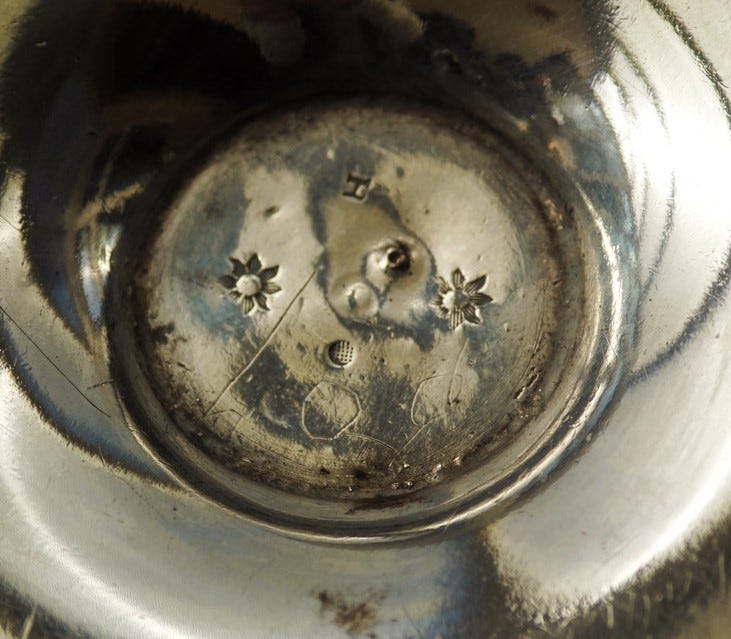
Probably the twin suns maker’s mark of Matthew Boulton, registered 1784. The H is likely to be the craftsman’s personal mark, which could be used in calculating his wages.


Unlike electroplating, the process of making OSP begins with making the silver plate. This involves taking a block of solid copper, laying on it a sheet of solid silver, and fusing them together in a furnace, causing a thin middle layer of copper / silver alloy to emerge at the junction and form a permanent bond. The block is then rolled in a mill until it is a thin sheet which is silver on one side and copper on the other. The desired item is then crafted from the sheet.

This was a more expensive process than electroplating, because the silver is involved from the very first, and you couldn’t economise by placing base metal items in stock until an order came in, at which point the essentially already finished product could have the silver layer added. With OSP your only viable economy was to tin interior surfaces that were rarely seen, such as the inside of teapots, rather than putting another layer of silver on the other side of the block where the interior was to be exposed, such as a fruit bowl.

This egg cup was made of double-sided OSP, but the interior silver was either thinner or has been partially polished away. You can clearly see, on the outside, the originally disguised seam, showing that the bowl was made from sheet, not pressed out in one pie

Not all OSP was actually made in Sheffield. Although Sheffield ware was deemed the best, Birmingham overtook the original city’s producers in quantity. Some production by the same process was undertaken in France about forty or fifty years after Sheffield had invented it.

To my eyes, OSP looks a warmer silver than EP, which seems to me quite cold. It may just be my imagination. Certainly, when you over-polish OSP, you see a warm tone of copper ‘bleeding’ through the silver, especially on exposed ridges. Since, with limited exceptions, even the youngest OSP pieces are approaching their second centenary, the collector can, these days, tolerate a limited evidence of the copper underneath, but personally, I don’t really care for pieces so worn that they resemble copper objects with a bit of residual silver trim.

It’s a wonderful thought that your coffee pot might have graced the table of some affluent merchant’s dwelling decades before the independence of The USA, your tankard may have sailed the seas with an officer of Nelson’s navy, or your candlestick lighted Jane Austen’s way to bed. And though yours may have had a more prosaic history, somebody somewhere probably has those very pieces, because these things last a long time.


The great thing is that small pieces are still relatively inexpensive. But, like any silver, if you expose it to a lot of fresh air, it will oxidize and tarnish. Ideally, it should be displayed in a glass fronted cupboard with a tightly closing door. You don’t want to polish it more than you have to, because each oxidization and polishing away of the oxide erodes the silver coating.

Friday, 7 March 2025

Choosing Words Carefully


JD Vance seems to believe that Donald Trump is a man who chooses his words carefully.

Donald Trump seems to believe that the statement, "Mexico will not be required to pay tariffs on anything," makes sense.

I can hardly believe he said that. Is there a chance he was misreported?

I'm sure Mexico is relieved to hear that the amount it will pay in US tariffs is, always was, and always will be zero. A US tariff is paid by US importers and / or US customers.

Does Trump not know this? He doesn't actually believe he has power to tax foreign countries, does he?

Could anyone suggest to me what Trump might have said on this issue had he not been choosing his words carefully?