Monday, 4 November 2013

Taiga Bean Geese


Probably the most famous inhabitants of Sliabh Mannan, considerably more famous than your present correspondent, are the overwintering Taiga Bean Geese (anser fabalis).
There are only two regular wintering grounds for this species in the UK, the other being in Norfolk. The Sliabh Mannan bean goose population consists of about 250 birds and has been carefully monitored since 1992. In 2008 the area was protected under the EU Birds Directive. This year a tracking study, in which local schools participated, found that the summer home of our geese is northern Sweden. For some reason I had been convinced that they came from Russia, which shows you how little of the bean goose language I really understand.
"Are we nearly there yet?"
"Honk!"
"You've been saying that since Spitzbergen!"
Honk!"
It is of course a very loud language, particularly when flights of well over a hundred birds pass overhead together in their characteristic V-formations. This autumn, if I interpret my records correctly, I saw my first bean goose flight on 27 September. For several days I was being confused by a smart rook who went around imitating goose calls and making me believe that they were early.
From time to time in my winter wanderings I come across hopeful twitchers equipped with binoculars and a great deal of optimism. Around my home we have never seen the birds on the ground, but overflight is common. I get the impression that training flights build up in the new year, prior to the spring departure. Well, it's a long way across the North Sea, you know!
"So, does that mean we're nearly there, then?"
"Honk!"

Sunday, 3 November 2013

Budapest

In tourist shops around the Hungarian capital they are fond of selling tee-shirts bearing the motto, "Good girls go to Heaven. Bad girls go to Budapest." I am far too old to understand what they mean, but they seem to be enjoying themselves. I did not go to Budapest to find bad girls. In fact I cannot recall with any certainty what I expected to find. The lack of expectation perhaps enhanced the very agreeable surprise when I got there. The city is imposing, picturesque and charming, as well as remarkably cosmopolitan in its cultural and architectural heritage. It has of course been disputed between rival cultures for much of its history.
Upon arrival, the captain of our riverboat obliged us by sailing downstream to the inner city limits before returning upstream to our berth. The Danube on a fine day affords glorious views of the twin cities, high Buda on one bank, low-lying Pest on the other, that were united in the late nineteenth century. The fine series of bridges connecting the two were all destroyed in the war but are now reconstructed and restored to their former glory. When the principal buildings on each bank are illuminated after dark on a warm, fine night, the entranced viewer might very well have been transported into a fairyland.
The remarkable parliament building, the centrepiece of the old Austro-Hungarian Empire, is far too large for today's small Hungarian state. At the same time it must be one of the most picturesque legislatures in the world, and one of the most photographed. When once you recognise the building, you seem to see it everywhere in travel advertisements.
Almost equally stunning is the huge expanse of Heroes Square, which contains some of the most beautiful equestrian statuary that I have ever seen and which is flanked by two national museums. The ornate baroque Basilica of St Stephen's is another architectural highlight. In Buda, the magnificent views from the heights of the Castle district are not to be missed. Wandering around the hilly medieval streets of old Buda is demanding on the legs, but educational.
If your legs will still stand it, there is a fine covered market in Pest that offers an interesting range of local products and foodstuffs, but it's on more than one floor and takes a long time to get round. Why is it so often the case that markets tell you as much or more about the local culture than the guidebooks? I think perhaps that whilst buildings impress us, people fascinate us. Sharing a market used by local people helps us to feel that we belong.

Saturday, 2 November 2013

Sharing a Currency

A modern economy is based on achieving efficiency by specialisation and then exchanging produce with other specialists. A currency facilitates exchanges because it gets round all the problems of having to barter. You might therefore think that in principle it would be good to share a currency with as many as possible of those with whom you hope to trade. The problem is that a currency has to perform other functions too. For example it measures value and value is not the same everywhere and to everyone.
The Euro was the EU's response to the failure of attempts to fix exchange rates between EU members by means of the so-called 'Snake'. The Snake was overwhelmed by market forces. Politicians believed that this could not happen to a currency union. The truth is that a currency union does not make the market forces go away, it simply diverts them into other channels.
The Euro is not a currency in which all members are equal. For most of the Eurozone's members it is effectively a foreign currency except for the absence of exchange costs. Market forces do not give equal weight to small economies and big economies. This means that all along the Euro has been in reality a Deutschmark-lite.
If you use a foreign currency you also accept a foreign country’s monetary policy, whether it is appropriate for your economy or not. You cannot simply demand that the foreign country takes account of your needs if they conflict with its own. 
Inappropriately low Euro interest rates before 2008 therefore fuelled unsustainable credit expansion and property booms in several weaker economies than Germany that needed more monetary discipline. This contributed to a series of crises as soon as the currency union came under serious stress. Meanwhile for Germany the Euro offered an artificially lowered exchange rate that allowed faster export-led economic growth than was justified by German costs of production.
Just like the Euro in Ireland or Greece, the pound will be effectively a foreign currency for an independent Scotland whether or not a Sterling Area is agreed and whether or not parity of status is claimed by politicians.  RUK is about ten times the size of Scotland.   An independent Scotland using the pound will have to accept what will essentially be the RUK's monetary policy.
The claim that an independent Scotland would become entitled to a seat on the Bank of England's Monetary Policy Committee is misleading at best. The independent status of the Bank (since 1997) precludes any government exercising influence over the MPC, which comprises Bank executives and independent economists. The UK Treasury representative who attends its meetings is not allowed to vote. Who could imagine that a Scottish government representative, even if allowed to attend, could have a greater role?

Friday, 1 November 2013

Scotland's Currency

A long time ago, when the earth was young and dinosaurs still stalked the uplands of Sliabh Mannan, I trained as an economist. I say this in order to justify a limited intervention in the independence debate. Mine is an economic commentary, not a political one. Substituting politics for economics was what led Europe into the débacle of its single currency and, since this precedent should not be emulated by the wise, I wish to examine the question of a currency for Scotland.
Any modern economy requires a currency. The fundamental choice is between one of your own and someone else's. Until recently, no-one was seriously suggesting that Scotland should adopt its own. In theory, creating your own currency is the only way to attempt monetary independence, since sharing a currency involves sharing sovereignty over monetary policy. In practice however, no open economy has full monetary sovereignty anyway, since the foreign exchange markets are too large for governments to control. It would not be impossible for Scotland to adopt its own currency. It would be expensive and it might be risky.
For a small and trade-dependent economy such as Scotland's, a new currency might seem an undesirable course, since it automatically introduces barriers to trade in the form of exchange costs. Unnecessary barriers to trade reduce the competitiveness of an economy and with it the standard of living in the country. To introduce barriers to trade with England, Scotland's principal market, would seem a bad way to start on an attempt to increase prosperity.
A new currency would also be vulnerable to exchange rate fluctuations. It would be more vulnerable than sterling to oil price changes, since oil is more significant in the context of the Scottish economy than that of the UK. An erratic currency handicaps trade by forcing buyers and sellers to protect themselves against unpredictable exchange rate changes.
The currency might well be discounted against sterling until traders became confident of its stability (and this discount would be greatly increased should the Scottish Government carry through its 2013 threat to refuse its share of the UK National Debt). It seems not unlikely that Scottish interest rates would have to rise relative to those of the residual UK in order to defend the Scottish currency. Investment would thus be adversely affected.
In all probability an independent Scotland would therefore be obliged to use an existing currency. Given that the majority of Scottish trade would be with England it would make most sense to use the pound. The only viable alternative would be the Euro, which is currently enduring an unresolved long term crisis, rather like a householder who pushes filler into the cracks in his walls and resolutely refuses to inquire why they have cracks in the first place.
In a future article I shall return to the economic implications of a shared currency.

Thursday, 31 October 2013

Paridae

Four species of tit are to be found around Sliabh Mannan.  Three of them come to my garden.  Sometimes on a grey day they can be hard to distinguish by sight.  The easiest to confuse are the great tit (parus major) ( top left) and the coal tit (parus ater) (second from top).  


The naked eye is drawn straight to the white cheeks and black cap that the two species have in common and although the great tit is larger this is not much help if you don't see the two together. 
A good distinguishing feature is the bright yellow underparts with a black stripe down the middle of the belly of the great tit, whilst the coal tit has what you might call dull buff / pink underparts. The black "cheek strap" is usually incomplete in the coal tit, which also has a white stripe down the nape of its neck, (not seen in this picture.)

 
The blue tit (parus caerulis) (left) is much more easily distinguished by its colour though this can sometimes be a little dowdy in winter. One pair obligingly occupied a nest box outside my kitchen window and very kindly cleaned house after raising a family and moving out.


It is interesting that these three species seem quite at ease with each other, as well as with other individuals of their own species. I have observed none of the sort of territorial feuding that can often be seen, for example, amongst robins. 

The fourth species to be found in woodland around the moor is the long tailed tit (aegithalos caudatus).  There is no mistaking these, but they skitter and are reluctant to pose for the photographer, chattering away to each other and performing acrobatic manoeuvres in the shrubs and trees.
 The whole extended family is numerous locally and often to be heard even when not seen.

Wednesday, 30 October 2013

Buzzards

Only two species of daylight raptor are at all common in the skies above Sliabh Mannan, buzzards and kestrels. Owls are frequently to be heard at night but almost impossible to see amongst the woodland. I have not yet succeeded in photographing one.
The more common of the daylight birds of prey is the buzzard (buteo buteo). A neighbour of mine claims to have once seen a dozen in the air at one time; I have a feeling that I may once have seen as many as five, but the memory is too hazy to attest with any certainty.
One pair breeds annually in a wood not far from my home and they are frequently to be seen hunting over the open farmland and the embankments of the long-defunct railway line that used to carry coal across the moor. At high altitude a buzzard is capable of spectacular soaring flight.
In the last couple of years another bird, perhaps one of their offspring, has also moved into the area. This one is remarkably noisy, regularly mewing in flight and advertising his presence to every rabbit and vole in the area. I am not sure why this method should be effective, but since he has been around for at least two seasons he is evidently not starving.
When out walking, I am quite often alerted to the presence of a buzzard by a tremendous commotion amongst local rooks, who resent the intrusion of a predator into their airspace and frequently despatch a squadron of interceptors to see him off. At low altitudes buzzards are cumbersome, lumbering flyers, easily outmanoeuvred by rooks and other smaller, nimbler birds who will readily mob them.
Even single rooks think nothing of attacking an interloping buzzard in the air. I have seen rooks dive into the attack with such speed that it seems inevitable there will be a mid-air collision. Once I wondered whether an impact had truly happened, but both birds went on seemingly unharmed. Usually the buzzard decides to pretend that he was already on his way somewhere less noisy and departs, escorted on his way by a final patrol rook. Honour is perhaps satisfied, but the observer on the ground is not fooled.

Tuesday, 29 October 2013

Pompeii

“The city of the dead,” Sir Walter Scott called it. The re-emergence of Pompeii from its seventeen centuries of entombment evoked the reverent awe of our forebears, who bequeathed to us masterpieces of their creative art depicting the disaster of 79 AD. Hardly anyone has read Bulwer-Lytton's novel, 'The Last Days of Pompeii', but everyone knows its name and modern picture books of the same title are still on sale outside the ruins. Modern writers and film makers have also been inspired by the story. But today, as one of the fifty most visited tourist sites in the world, Pompeii is too crowded with the living to evoke a ghostly atmosphere for any but the most self-contained observer.
Although the determined photographer may, with patience, still capture close-ups of uninhabited buildings, a longer shot inevitably includes an incongruous miscellany of people dressed in tee-shirts, shorts and sun hats, some dragging unwilling children, some in silence, some eagerly discoursing in all the languages of the earth and most in straggling, sweaty pursuit of a bronzed and athletic guide whose muscles have been toned by a couple of pedestrian circuits of the hilly city each day. A contemplative reverie as you endeavour to recreate in your mind the daily life of the past is sure to be interrupted.
Following excavation, exposure to the elements now combines with the corrosive effect of two and a half million visitors annually to tarnish the archaeological jewel that has fired our imaginations. Yet a fortune is required to preserve what has already been unearthed, and another fortune to excavate a third of the ancient city that remains buried. How are these funds to be raised, particularly in an age of financial austerity, but by promotion of the very tourism that exacerbates the problem? Scott's ghosts now flee from the invading hordes who, as Wilde observed, kill the things they love. Not long after my visit I was saddened to hear of the collapse of a wall in the gladiators' school (right), which I had myself visited.

Somehow though, the vulgar throngs and accelerating decay cannot subdue the wonder of Pompeii. Stand in its cobbled streets and gaze towards brooding Vesuvius, marvelling at how fully life can be lived on the edge of destruction. Pompeii’s citizens, like their modern Neapolitan heirs, convinced themselves that the fire of Vulcan’s forge was dowsed for good. Baths and restaurants, temples and brothels, villas and theatres cluster around the spacious forum; every street immersing us in the infrastructure of an exotic yet strangely familiar culture.
For those who remember the rebellious flowering of the 1960’s, the so-called degeneracy of Pompeii resembles nothing so much as the bountiful but brittle culture that flourished in the early shadow of the bomb; there is the same determination to enjoy life and to ignore convention, to create, to experience, to push forward all kinds of frontiers, to laugh at risk, to live for the day.
In a way we envy the citizens of Pompeii just as we look back nostalgically on these our former selves. They were, perhaps, wrong; we were, perhaps, wrong; but somehow it all feels worth it, not only for its own time but for what it has left behind.

Monday, 28 October 2013

Common Species


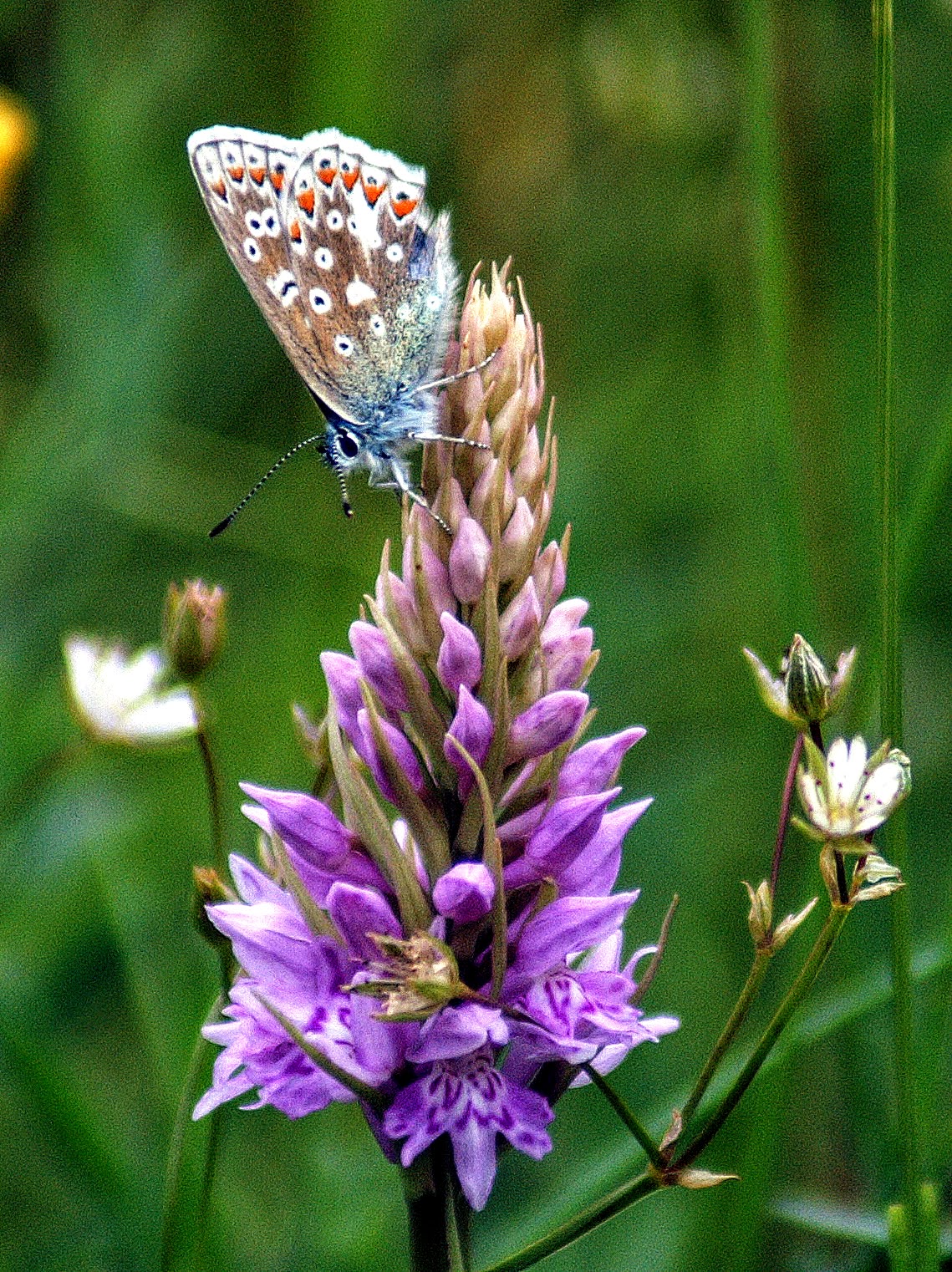
Of all the many nature photographs that I have taken in more than forty years of wandering about on Sliabh Mannan, mostly in company with a dog, this is one of my favourites.  The remarkable thing was that both of the featured species are officially called 'common', whilst for my part I had never seen either before.  I had to turn to the well-thumbed pages of one of my reference books in order to establish that I had now observed the common blue butterfly (polyommatus icarus) feeding from a flower of the common spotted orchid (dactylorhiza fuchsii).
The year was 2011 and the month was July. As I recall it had not been much of a summer for people, but for some reason there were wild orchids all over the moor and in every field. I have a friend who knows about orchids, but unfortunately I did not happen to meet him during this extraordinary period. Had I chanced upon him I dare say that he could have explained to me what was happening. I was just left to wonder at it.
I suppose that a botanist would find nothing particularly strange in a flower species suddenly appearing in an area where it has been largely unknown before. For me the movement of flora is even more mysterious than the movement of fauna, and I don't understand as much about that as I should like to do. The one thing that I can certainly say is that these unusual common species brightened a climatically fairly dull season.

Sunday, 27 October 2013

Kinderdijk

This is Kinderdijk in the Netherlands, visited during a wonderful European river cruise that I enjoyed this summer.  If you ever get the chance to visit Kinderdijk on a sunny day you should certainly take it. I have seldom enjoyed a wander more. This is both an engineering marvel and an amateur ornithologist's paradise.

To begin with the engineering, the dry land here is three big steps down from the River Lek (Rhine). There is a canal and reservoir system through which the mills lift the water to the height of the river. All of the mills are driving pumps; none of them are milling corn. The area around the mills, and  one of the mills itself, can be visited, but the land that they are actually draining is in use for agriculture.
There is a saying apparently "God made the world but the Dutch made the Netherlands" and this is one of the polder areas where this is true. We were approaching the former Zuyder Zee, an arm of the North Sea which is now much reduced in size and has become a freshwater lake. If the mills stopped pumping it would take about three months for the polder to flood completely.

Now because of the canals and reservoirs and reed beds you have a little natural wonderland. The first thing I spotted was a cormorant; then a hovering marsh harrier (a first for me) then coots and grebes and geese and ducks of several varieties. I could happily have stayed there much longer and I do wish I had been warned to carry my 400mm lens. This is old and so heavy that I tend to use it just from wherever my base at the time happens to be, but it would have been worth lumping it around for this opportunity.

Fortunately I was carrying my 300mm zoom, so this great crested grebe is an example of the sort of photographs that were possible there.  The grebe was unconcerned about the visitors, most of whom in fact had eyes only for windmills (understandably) and perhaps did not even notice him.  Since it was relatively early in the day, the grebe's mind was still on finding some breakfast.

Introducing Myself

I am a writer. Most of the time I write stories. From time to time I write poetry or articles. Once in a blue moon I write a play.
As a general rule I quite like what I write. That does not make me unique; very few people spend their time writing things that they don't like. Occasionally magazine editors say that they like what I write too, but only rarely do they like it enough to print it. This means that mostly you don't get to read what I write.
This blog is going to be different. You can make your own decision whether to read it; you won't need an editor to take the decision on your behalf.
It's also going to be different in that I am not going to be writing stories here. I have had the good fortune to travel quite widely and many of the places and things that I have seen are worthy of comment. I am also lucky to live in Sliabh Mannan (left) where people and nature are close together and affect each other in important ways. So I shall be writing about landscape, buildings, creatures and habitats.
I may sometimes write about people, but I don't intend to spend an inordinate amount of time on politics. There is no shortage of political commentary and I am more interested in how people think than in what they conclude.
So there are my ground rules. Welcome to The View from Sliabh Mannan.