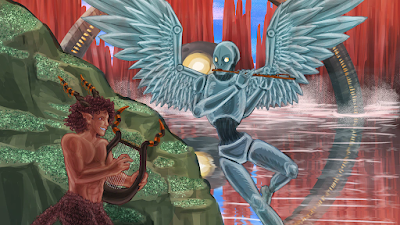
Monday, 26 December 2022

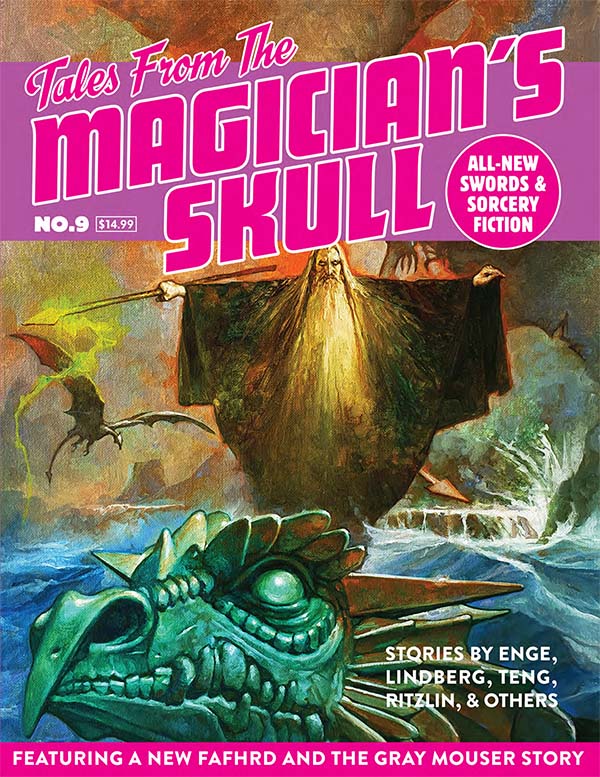
Tales From The Magician's Skull #9


The Raven-Feeder’s Tower by Philip Brian Hall

The skeleton was held upright by a tall stake driven deep into the ground, to which support its spine was fixed by leather bonds. The breastplate covered bare white ribs and the helmet’s visor protected merely the empty eye-sockets of a morbidly-grinning skull.

I really like this story. I hope you do too.


Saturday, 17 December 2022

How do horses feel knowing that automotive has replaced them? Is it why they have this saddened face? (Quora)


I doubt that many living horses have been replaced by automobiles. It is true that Her Late Majesty Queen Elizabeth II had long since, through age, given up riding a horse at the annual Trooping the Colour parade, but to the best of my recollection she had continued to use horse-drawn carriages for other ceremonial occasions in London.

Horses are just better at pageantry than motor vehicles, and tedious parades of mechanical weaponry are really best left to unimaginative foreign dictators who like that sort of thing, and to their oppressed subjects who seem to appreciate it..

Until well into the twentieth century the horse was integral to society. Specialised breeds of horses could do everything from pulling logs out of barely-accessible forestry plantations to carrying elegant ladies side-saddle on fashionable excursions down Rotten Row. Cavalry horses, well used, would regularly turn the tide of land battles, while draught horses transported everything, everywhere, including providing the source of power for canal barges during the Industrial Revolution. Plough horses were vital to agriculture; race horses provided a principal source of entertainment that enthralled everyone from dukes to dockers.

I once tried to illustrate some of the varieties of equestrian leisure in a cartoon:


But it is a mistake to conceive of a horse as having an extensive capacity for abstract thought. His world revolves around the food, stabling, exercise, care and attention that he receives from his owners or grooms. He has no trouble communicating his likes and dislikes in respect of that treatment. He knows whether he is treated well or neglected. He knows his rank in the domestic herd: he does not know how important his ancestors were to our ancestors. He knows if he is good at what he does, and he may well appreciate praise for a top class performance, but he does not know that the role of the horse in society has changed, is changing, and will continue to change.

So, while it may or may not be true that in a specific employment a machine might be more economical, to my mind, people who think that horses can always be replaced must be people who have never worked with horses.

And the reason a horse needs a long face should be obvious. This is Buster. He is not sad.


Saturday, 19 November 2022

What did Socrates mean when he said "I know that I know nothing"? (Quora)

Plato, who recorded the words of Socrates
It would have been most unlike Socrates, whose analytical technique (called elenchus) was based upon exposing contradictions in the statements of other people, to express himself in a contradiction. Obviously anything that I know is something, therefore if I claim that I know I know nothing, I am contradicting myself.

If, however, I start from the assumption that I know nothing, I may ask anyone who claims knowledge to explain a particular aspect of what it is that they know. Usually Socrates would invite his interlocutors to state a generally-applicable principle, and then he would offer a specific instance of the principle’s non-applicability. This would lead to the interlocutor redefining the principle more narrowly. The process would be repeated until it could be repeated no further, at which point Socrates would deem that they had arrived at a truth.

The process has considerable merit, but is inevitably limited in scope. Ironically, Donald Rumsfeld’s much-derided, but actually important, categorisation of knowledge into known knowns, known unknowns and unknown unknowns helps us to understand this.

Most people are aware that there are limitations to their knowledge (or known knowns); for them there exist known unknowns. So, for example, I am aware that there is a field of human knowledge called quantum mechanics, but I have no detailed understanding of what that field encompasses.

Unknown unknowns have been usefully defined as “phenomena which cannot be expected because there has been no prior experience or theoretical basis for expecting the phenomena”.

But in later life Rumsfeld came to acknowledge the existence of a further category, possibly the most problematical of all, that of unknown knowns. These he defined as "the things you think you know, that it turns out you did not".

Like Rick in Casablanca, we can be misinformed. Sadly, we may act upon mistaken beliefs with all the intensity that would ideally be reserved for genuine certainties.

So, if we return to Socrates, we find that even the little that we think we know may be just waiting for some counter-argument or evidence to turn up.

Saturday, 12 November 2022

Does Scotland really needs a referendum to get its independence? After all, they didn't need a referendum to join the union? (Quora)


Our island history is of a long series of ‘Unions’.

When Dalriada was united with Pictland to form Alba, was Alba one country or a union? When Alba was united with northern Northumbria to form Scotland, was Scotland one country or a union? When Northern Strathclyde was incorporated into Scotland, was the resulting country then a union? Likewise, when the Western and Northern Isles were incorporated into Scotland? Did each and every one of these former countries retain a right to secede?

Meanwhile further unions were taking place in the south to form a country called England out of countries called Wessex, Cornwall, Kent, Essex, Mercia, Northumbria, Rheged etc. Wales was the last piece to be fitted into this jigsaw.

I think it is quite important to mention these earlier amalgamations, because current discussions seem to take for granted that all of England is culturally the same, or that there is only one historic culture in Scotland.

Eventually the island consisted of only two kingdoms, each of which came first under the same rule, (effectively putting an end to border reiving, because malefactors could no longer flee from one king’s jurisdiction to the other’s), and then the two of them united together into one country called Great Britain.

What exactly is supposed to make the union, in 1707, of these two remaining kingdoms somehow different from all the unions between then-existing countries on this island that went before?

And incidentally, since both the formerly-divided former kingdoms of Northumbria and Strathclyde were at long last actually reunited in 1707, should we, as an alternative option, be offering a referendum to their residents to ascertain if they want to be split up again between their respective former owners?

A Political Parable

In politics, there are lighthouses, and there are sailing ships. There are far, far more of the latter. The lighthouse will stand where it stands, regardless of tempests, but when the weather gets rough, the sailing ships will run before the wind, irrespective of which way the wind is blowing. When the wind veers, the sailing ships can be blown right back where they started or even beyond. The lighthouse will still be where they last saw it.

Much more important than following the behaviour of the sailing ships therefore, is understanding what meteorological factors are causing the wind.

The most successful politicians will probably be ships. The most respected will usually be lighthouses.

Sadly, of course, whilst a ship may occasionally be blown on the rocks, a lot of lighthouses are on the rocks to start with!

Saturday, 17 September 2022

What are the advantages of "cancel culture"? (Quora)

I tend to think of cancel culture as a version of totalitarianism. You are allowed to say anything you like, providing it is consistent with currently fashionable moral and political orthodoxy.

Any public espousal of heterodox views will result in a torrent of threats and abuse. You will be reported to the authorities. You may be investigated by the police for committing a ‘non-crime hate incident’. Your employer will come under pressure to dismiss you. Your products or artworks will be boycotted simply because they are yours. You will be falsely portrayed as ‘whatever-it-is-phobic’ by people who do not understand the meaning of ‘phobia’.

In short, you will become an unperson, airbrushed from historic photographs, deleted from records and in all respects treated by bien-pensants as though you did not exist.

The advantages for the bien-pensants include:

1. You don’t have to bother engaging with what a cancelled person actually says. This saves a lot of mental effort.

2. You don’t need to come up with rational counter-arguments. This saves exposing your own limitations.

3. Once the thought-police have pronounced the cancelled person guilty, you don’t need any further evidence. A cancellation is good for all time, since it is well known that leopards never change their spots.

4. You are not exposed to any potentially disturbing suggestions that you might just conceivably be wrong.

5. The people upon whose behalf you take offence will appreciate your speaking up for them. And, if they don’t, they aren’t really proper victims at all but collaborators, and you can be rude to them without incurring the penalty of being cancelled yourself.

6. You get to invent neologisms and acronyms to use as insults towards the people you cancel. This enables you to make your mark on the world and enrich the language. (You should be careful to avoid looking in a dictionary to check for pre-existing words). You can display your erudition by using dead classical languages when making up these new words, even if you don’t actually know what words mean in dead classical languages, because no-one dare argue.

7. If you are a student, you can get rid of any teacher you don’t like or who gives you bad grades.

8. If you are a teacher you can threaten with cancellation any student who might have the potential to expose your ignorance or shortcomings.

9. You don’t need to trouble yourself to invent or create anything good. You could become famous simply for tearing things down.

10. You get to feel self-righteous, superior and smug.

11. You get to hate and be intolerant while still describing yourself as liberal. This gives you the best of both worlds.

12. And by the time anyone realises that nothing original and beneficial is coming out of the conformist and obsequious society you have created, you will be too old to care.
Tuesday, 16 August 2022

What is the reason that science fiction is considered "literature" despite the poor writing quality of much of it? (Quora answer)

Bad writing is not usually considered literature, no matter what its genre.

Science fiction writing, like writing in other genres, is only usually considered literature if it is good writing.

Most writing is bad writing. Some writing is good writing. Good writing is good writing no matter what its genre, though what makes writing good is not necessarily the same in all genres.

A writer who can’t write but enjoys writing is not all that different from someone who enjoys singing but can’t sing or who enjoys painting but can’t paint. If someone enjoys doing it, then the art has served a purpose. When someone enjoys reading what you have written, you have made an important step forward. Your close friends and relatives who tell you how good your writing is do not count.

In the modern age a lot of bad writing is self-published. Some good writing is self-published. Some bad writing is commercially published. Being commercially published is not proof that your work should be considered literature, but it’s a start.

The chances that someone will enjoy reading what you have written are better if your writing is good. The chances that your writing will be considered literature depend upon a whole host of other factors, but reader enjoyment is where everything starts.

Sunday, 14 August 2022

The Protest Diaries


Quite how I managed to get a story into this anthology, I'm not sure.  To begin with, I didn't submit a story to it. 

I did however submit two stories to 'Alternative War,'  which appeared some months ago. Since the longer of those two stories, AWOL, made it into that volume, it may be that the shorter one was transferred in this direction.  Or not.

Anyway,  'Interrogation for Beginners' is a story I like, and I hope you will like it too.  As the title suggests, it concerns a veteran interrogator who has to take time out of his regular business to interview a new recruit who is still very wet behind the ears. I hope this inevitable culture clash may contain a few useful thoughts.

Protest is often about culture clashes. Sometimes we tend to support the protesters and sometimes our sympathies lie with the authorities.  The point, in the case of this story, is that both the veteran and the recruit are on the same side; they just come from generations that differ over both ideals and methodology.  

Can we achieve desirable change without fragmenting society?  Eliminate the bad without destroying the good?  Are youthful ideas best, or do they need tempering by the wisdom of age?

These are among the things that I hope we may be inspired to think about.


Thursday, 23 June 2022

4th and Starlight


I'm delighted to say that 4th and Starlight is out, and features the first publication of a favourite story of mine, "The Long Con".

A young lady grifter is determined to prove herself the equal of all the famous con-men in her family, but when she accepts a challenge to date a space alien, it becomes unclear who's doing the conning.

Join these rising stars of science fiction and fantasy at the corner of Fourth and Starlight for a journey like no other.

Step into a world ravaged by robotic warfare to explore buried secrets, visit with a sleep-deprived mermaid, and journey to ancient Egypt to romance a Mourning Woman. Chase down an outlaw with a jaded bounty hunter, play in the woods with a little boy and his friend, or ride along on a haunted food truck. Let go of grief at the airport, flirt with a succubus, and survive a spaceship crash with a cyborg. Nineteen stories that will fill you with delight, inspire your imagination, get your heart pounding, and leave you misty-eyed with joy.

Stories by Mike Wyant Jr., K.L. Shwengel, Kary English, Philip Brian Hall, Rebecca Birch, Van Alrik, Kristy Evangelista, Preston Dennett, Dustin Adams, Y.M. Pang, M. Elizabeth Ticknor, Rebecca E. Treasure, Alicia Cay, Julia Ashley, John D. Payne, Rachelle Harp, and Dr. Robert Finegold.

Friday, 13 May 2022

Space Force ... and beyond!

My contributor copy of Space Force has arrived.

At the time of writing, B-Cubed are still the only publishers who will publish my poetry.  I like to think this shows discernment on their part.  

I normally write traditional ballads that both rhyme and scan.  These days, that seems to be a cardinal sin in a genre dominated by what I tend to call badly-punctuated prose. By this I mean that the only way you can recognise it as poetry is because it's in a poetry book.

There's no point getting annoyed about this, however.  The people in charge aren't going to change their minds, and all one can do is wait for the fashion to move on. 

I knew things were really bad one year that a TV gardening programme ran a poetry competition and all the first four poems were "free verse."

Anyhow, The Space Force Hymn is a little skit on the US Marine Hymn, "From the Halls of Montezuma" which is written in the good old style.


Tuesday, 10 May 2022

Why isn't Britain apologizing for what they have done to this world? (From Quora)


When a question is self-contradictory, it does not help our understanding.

Britain is a singular noun which tends to be used as shorthand for Great Britain, the island which is in itself part of the United Kingdom of Great Britain and Northern Ireland. “They” is a plural pronoun and has no point of reference within the question.

Since the inanimate is presumably blameless, one is left to surmise that the persons intended by “they” may be the inhabitants of the aforementioned island, presumably the living ones, since the dead ones are in no position to apologise for anything. However, it is far from clear what the present inhabitants of Britain are alleged to have done.

Apologies only make sense when offered by the perpetrator of an offence to the victim. One cannot meaningfully apologise for things one has not done, (unless one ought to have done them, in which case we speak of sins of omission). Nor can one meaningfully apologise for what someone else has done. If offenders wish to apologise, they can apologise for themselves. If they do not wish to apologise, then no one else has the standing to apologise on their behalf.

No one is morally obliged to take responsibility for the behaviour of earlier generations. The present generation does not deserve credit for the good actions, nor blame for the bad actions, of earlier generations.

Reparations for bad actions that took place centuries ago cannot be required of current populations. In any case, it would be next to impossible to separate current populations into those who are and are not descended from the alleged perpetrators. To give just one example, what sense does it make to demand compensation be paid by descendants of an oppressed English factory worker of the late eighteenth century to descendants of an oppressed plantation slave of the late eighteenth century? It should be needless to point out that far more of the current British population are descended from factory hands than from capitalists.

As Cicero said, “O tempora! O mores!” We cannot retrospectively impose our values on the past and hope to emerge from that abstract process with anything resembling a fair judgement. Iconoclasts who think that, by erasing visible signs and symbols of the past, they will achieve anything positive, are simply deluded. You cannot punish the dead; they are immune to your rancour. You can only increase the likelihood that the living will forget the mistakes of the past and hence, through ignorance, increase the risk of repetitions of those errors in the future. In short, one man’s current virtue signalling is another man’s unforgivable cultural vandalism.

For good or ill, the past is gone. The present and the future have more than enough challenges for the living.

Tuesday, 3 May 2022

Boris Johnson compared the struggle of Ukrainians fighting Russia's invasion to people in Britain voting for Brexit. What are your thoughts? (From Quora)


We have known this principle for a very long time. “Every kingdom divided against itself is brought to desolation; and every city or house divided against itself shall not stand”. (Matthew 12:25)

There is a fine line to be drawn between loyal opposition and actively undermining the policies of one’s country.

The spectrum of loyalty ranges from,“My country, right or wrong,” at one extreme, to “My way or the highway,” at the other. Those who espouse the latter position are so utterly confident of the correctness of their position that they despise those who disagree with them and can never be reconciled to losing a democratic vote.

The similarities between Putin, who could not accept the removal of his Ukrainian puppet and immediately began scheming to recover by force what he could not have any other way, and the relatively small number of Extreme Remainers in the UK who were, and still are, determined to reverse a popular vote, are quite striking, even if the violence employed by the latter is, fortunately, confined to language.

Immediate resort to abuse, with no attempt at reasoning, is common to both. Brexiteers are no more stupid than Zelensky is Nazi, but caricaturing your opponent rather than treating him as a human being with legitimate rights and aspirations, makes it easier both to hate and to incite hatred.

Clinging to a past that, if it ever existed at all, is viewed through rose-tinted spectacles, holding grudges long after the justification has gone, wilfully misinterpreting any and every event as proof of your own prejudice, and obstinately refusing to adapt and advance are also common characteristics.

At the very least, this sort of attitude is tedious, frustrating and insulting to those who don’t share it. At the worst it will destroy a society rather than see it change in any direction other than the desired one.

And in the end, some people would rather sit amidst the rubble (which in one case may be metaphorical) and say ‘I told you so,’ than share in a prosperous future that is not achieved by their desired method.

I don’t know whether this is what the PM was saying. It’s just the direction my thoughts took after seeing the question.

Friday, 7 January 2022

Those who Justify Iconoclasm ( from Quora)

I did not follow the court proceedings closely. I did not hear the evidence. There may therefore be specific issues of which I am unaware, and upon which, in respect of this case, I am open to correction.

But essentially, at least on the face of it, the general issue appears to be whether having a moral justification gives a person a free pass to break laws.

In a free society, people can legally change the government, change the law and bring about various other changes through legal means. There exist legal mechanisms for redress of grievances. So what excuses a resort to extra-legal direct action?

This is a fundamental principle. Should we, in a free society, concede the existence of a moral justification for prima facie lawbreaking? If we find it tempting to do so when we agree with the claimed justification, what happens when we don’t?

Once one has rejected the authority of law, how is one to distinguish between acceptable and unacceptable claims of moral justification? If, secure in my self-righteousness, I am entitled to decide the law does not apply to me, by what right or means shall I insist it applies to other people?

Unfortunately, a precedent for one is a precedent for all. To apply one rule to your moral allies and another to your opponents is not a principle that favours prolonged continuance of freedom in our society.

Thursday, 9 December 2021

Reminiscing about The Owls (Sheffield Wednesday)

The past is always with us. Even though I’ve exceeded my allotted biblical span, it’s still quite easy for me to see in my mind’s eye a playback of Alan Finney making Roma’s international right back look clumsy, or Don Megson depositing both the ball and some nippy right winger along with it into the advertising hoardings. We were League runners-up behind a double winning Spurs team when achieving the double was something almost unheard of.

At the time I was a half-decent athlete myself. I was rowing at Henley before the end of the decade. Now I have arthritis in my wrists and a shoulder that constantly reminds me of all the falls I took when I changed sports and became a steeplechase amateur jockey.

My best Wednesday memories date back the best part of a lifetime. You have to be my age to remember it, and most people, fortunately for them, are not my age.

My own sporting career is similarly a thing of the past. But that doesn’t mean I can’t turn to something else. You work with what you have, you try coming at life from a different direction. I discovered I can write and people want to publish what I write. (Some of the time – you can’t win ‘em all.)

Like me, Wednesday are not what they were. But most of the things that matter are still here. The heart’s still beating; the supporters still believe; the team still matters because it’s a collective focus of potential achievement for a city population and diaspora that have had at least their fair share of hard knocks, if not more.

As I said, you work with what you have. You will find you still have a lot that’s worthwhile. Just don’t let the bastards grind you down.

Thursday, 18 November 2021

Alternative War


New from B Cubed Press
I don't know why, but Amazon has a recurring problem with including my name in lists of contributing authors.  

So, despite the fact that I'm once again not listed, I have indeed got a story in Alternative War, the new release from B Cubed Press.

'AWOL' is the story of a marine sergeant who has the misfortune to be elsewhere, sleeping off a bender, when her base is suddenly evacuated as the enemy advance gets too close.  

So what's new, you say?  Common enough difficulty; could happen to anyone.  

True, but not everyone was already particularly unpopular on all sides for smuggling in bootleg whisky within the president's personal supplies.  

Hardly anyone managed to combine that little misdemeanour with being a member of the presidential bodyguard.

And absolutely no-one else packaged both of these mistakes with being part of the Earth garrison on the planet Kyron.


This is the story of Jackie Carnegie, the only Earth soldier left on a planet being invaded by a cruel and relentless race of aliens when the planetary defence forces surrender. She can't get off the planet. Should she run away and hide? Should she embark on a foolhardy one woman war? Does she have any choice?

Well, you'll need to read the book to find out, won't you?

Saturday, 6 November 2021

Coming soon - Fourth and Starlight


Fourth and Starlight
I'm very pleased to announce that my story 'The Long Con' will appear in the new Starlight anthology, Fourth and Starlight, edited by Elizabeth Ticknor, who has also produced the cover art (left).

I'm really fond of this story, which marked a considerable step forward for me as a writer.  It was the first time I'd attempted to write a story about a female protagonist who suffered discrimination on account of being female.

The woman in question is a con artist from a family of con artists.  So far, so good, but the family happen to consider that only men can be proficient in their trade.  Our heroine is determined to prove them wrong, no matter what low tricks she has to stoop to!

According to the PR blurb, this book will be "An illustrated anthology featuring compelling new voices and rising stars in the genres of science fiction and fantasy." And me, I suppose, since I'm not exactly either a new voice nor a rising star.  But you never know, do you.

Anyway the Kickstarter page is here, so you can sign up to be notified when it launches, if you like.

Thursday, 30 September 2021

Planting and Preparation Prevents Perverse Parsley Paucity

I read that posh people cannot find parsley or peppers in the shops. It took me a little while to figure out why they were going to the shops for things like these. 

To get peppers, I have to go to our conservatory (I know, delusions of grandeur or what?) where I have three pepper plants currently fruiting away merrily in pots. To get parsley I have to go as far as the cold frame in my garden, where I have far more than we can eat growing in a 12-inch by 18- inch box.

A little forethought, some compost and a packet of seeds, folks. I mean, if I can do it at 600 feet above sea level in cold, wet Scotland, anybody can.

Instead, the MSM will probably start another panic, just as they did with petrol. It’s becoming a little annoying how easily the Great British Public can be stampeded these days. Whatever happened to the stiff upper lip?

If you wanted to set yourself up as a prophet today, you’d have no need to do a complete Mother Shipton. Just start a scare story that there’s going to be a shortage of mince pies at Christmas and watch the self-fulfilling prediction unfold.

Saturday, 25 September 2021

Why do we need to use standard English and bias-free language in writing? (Quora)

If you want to write fiction, you can only use standard bias-free English all the time if all your characters are standard bias-free English-speaking persons.

You will find this difficult, because although quite a few people speak standard English, the only people who are bias-free are dead. Though many people may try to be, anyone claiming to be actually bias-free is either a fool or a liar.

All human beings are influenced by their upbringing and personal experience to see the world in a way that is peculiar to themselves, and that is assuming they all start with relatively similar perceptual apparatus. (Obviously if you have unusually good, unusually poor, or just different sight, hearing, taste, touch, smell or ESP, your perception of the world will differ from standard). This doesn’t mean your way of viewing the word is right or wrong, or even that there is a right and wrong, it just makes you honest when you acknowledge that it’s your way.

In addition, our senses are not set up to show us how the world is, but to show us how the world is in relation to ourselves. As an example, both the timing and the volume of a sound will differ according to how close you are to its origin, whilst if a light is associated with the sound, the light will reach a distant observer first. I well remember, on my first visit to a cricket match as a child, how puzzled I was by the delay between my seeing the batsman striking the ball and my hearing it. We simply do not possess and cannot acquire omniscience.

Particular care needs to be taken when dealing with the self-professed unbiased, who include some of the most biased and intolerant people you will ever meet.

As a writer of fiction, you can only be true to yourself. If you try to fit your writing around somebody else’s prejudices, you are likely to render it insipid and bland at best. I remember one writer who contrived to render a story quite unintelligible by substituting ‘they’ and ‘their’ for every masculine or feminine pronoun. Which is fine if you want to be insipid or unintelligible, but otherwise not.

A writer in a dictatorship or living under a totalitarian regime may not have this choice, but I still believe a writer in the free world should be able to choose to go full speed ahead and damn the torpedoes!

Wednesday, 22 September 2021

How should the old Brexit Slogans be Updated for 2021? (Quora)

I hesitated to answer this question, since the five-year-old ashes of the referendum campaign are stone-cold and blown away by a great wind called Covid that neither side foresaw.

In the wake of the genuinely catastrophic damage done to the world by that wind, the hyperbolic 2016 claims of Brexit catastrophe should ideally be quietly forgotten and the widely-foreseen adjustment problems of leaving the EU pale into insignificance. I don’t think efforts to blame Brexit for worldwide phenomena reflect much credit on those concerned.

Suffice it to say that nearly all Remain slogans should today be amended by the addition of a single word. The word in question is ‘not’. I’m sure you can work out for yourselves where it needs to be added in each case.

There really was only one important Leave slogan: ‘Take back control’. No-one seriously expected British politicians overnight to become hugely efficient paragons of virtue. In fact, we expected it to be quite tricky to take over from the remote pilot that had been charting our course for so long. But the crucial thing is, if British governments mess up, we can get rid of them.

As it happened, the first result of taking back control was the UK’s much-condemned, but in the event astute, decision to go it alone on the development and distribution of Covid vaccines. This led to an early start to the recovery of economic growth that outpaced the rest of the EU.

Major economic changes, like any long-term investment, usually have their costs front-loaded and benefits delayed. In the circumstances, the UK has been fortunate to see some early benefits. Before the pandemic, Leave-favouring economists tended to estimate five years or thereabouts to break-even. It may turn out to be slightly less; we’ll see.

But for better or worse, it’s done. What on earth is the point of seizing upon every piece of news that, unremarkably, tells us there are costs as well as benefits?

We need to go forward, not keep looking back to the road not taken.