
Saturday, 17 June 2023

Wednesday, 17 May 2023
A Most Unusual Proposal

Not only is this story "A Most Unusual Proposal", but it's a most unusual genre for Philip Brian Hall - an Edwardian comedy of manners. A sort of Saki / P G Wodehouse style of tale.
There are no spaceships. There are no magicians. The only battle involved is the battle of the sexes.
Worth reading for the novelty value alone!
Saturday, 13 May 2023
The Ultimate Irish American

Bull, meet china shop. Whoops, I probably shouldn't have said that.
I don't suppose there's anything anyone can do to stop him saying the sort of things he's just said back in the USA about how he had to go there to stop the Brits reneging on their agreements, but it went over like a lead balloon with the people whose agreement is still needed to get the Stormont parliament back up and running.
The theory is, American intervention is needed to hold the centre ground between two groups that can still barely talk to each other.
It is not all that helpful to endorse one side and shout "Hoorah!"
No, really, not even a little bit.
If at all possible, and in full awareness that foreign relations is not really at the top of US priorities, could you not find someone a tiny bit more worldly-wise?
Pretty please.
Friday, 5 May 2023
Mr Keynes’ Revolution – E J Barnes

“Mr Keynes’ Revolution” introduced me to Maynard Keynes the man, as opposed to Maynard Keynes the ground-breaking economist. In the aftermath of The First World War, the tectonic plates of economics had begun moving as surely as those of politics, but hardly anyone realised the earthquake was coming. The illusory safety of a return to the status quo antebellum appealed strongly to upper middle class financiers and public figures, who thought once they’d got over the inevitable punishment of the wicked Germans, the whole world could get back to normal and life could go on as if nothing had happened. Why was Keynes almost alone in perceiving that not only was the old way gone for ever, but that every great step aimed at reviving it, from The Treaty of Versailles to the return to The Gold Standard, was digging it an even deeper grave?
E J Barnes brings vividly to life Keynes’ transition from member of The Bloomsbury Set, a commune of artists and intellectuals, inhabiting their own world, and relying on other people to provide for their basic needs, to a campaigning newspaper owner fearlessly speaking truth to power, very much a man of the real world, and defiant of the ostracism that came his way because of his perceived treachery to his class. In particular, she focuses on the seminal importance of his remarkable love story, as the academic economic genius encounters an exiled Russian ballerina, also a star in her own firmament, but one only too well aware of the fragility of both her art and of civilisation itself.
In those social divisions of the 1920s, I see a parallel with recent years. We, too, are experiencing a ruinous European war and a near universal desire for the aggressor to be punished. We, too, have a country divided between a middle class who thought the EU offered the way of life they desired and a working class who saw their wages depressed and their livelihoods threatened. Those who escape class divisions of the past find themselves mired in the artificially-contrived strife of identity politics just when we need society to pull together. We see a world economy devastated by Covid just as the last century had its postwar influenza. We have a ruling elite with the same incomprehension of the larger picture and the same resistance to radical change, and we are again staggering from one world financial crisis to another because, as yet, we have no Keynes to show us how the institutions of our century must be reformed to cope with it all.
I recommend this book. It conveys a powerful message in wonderfully evocative and very readable prose.
Wednesday, 3 May 2023
Dragon Gems Spring 2023

Featuring stories by Veronica L. Asay, Warren Benedetto, Jason P. Burnham, Michael D. Burnside, Laura J. Campbell, Arasibo Campeche, Jay Caselberg, Philip Brian Hall, Tom Howard, Tim Kane, Benjamin C. Kinney, Stephen McQuiggan, Mike Morgan, Sam Muller, Jason Restrick, and Elyse Russell.
My story is "Dead Man's Hand", in which a space shipwreck survivor, on the point of starving to death, is unexpectedly dealt the opportunity of a lifetime.
This is the first to be published of a series of stories I'm writing about "The Wreck of the Hesperus", in which I follow the scattered survivors to disparate parts of the universe and some adventures I hope you'll find interesting. Maybe someday a collection, but meanwhile, a start.
Saturday, 25 March 2023
Trans Athletes
While society, for its purposes, may choose to distinguish between gender and biological sex, it seems illogical for sport in general to do the same without reservation.
The sex of the jockey may be of no significance to the horse in, say, racing or eventing, but it would certainly make a difference, to the point of being dangerous, in a female contact sport such as rugby.
Athletics falls between these two extremes. Physical danger is seldom present, but the advantages of male physique mean that even modest performers in male events can become champions in female events.
The result in the short run is to disappoint and discourage elite female-born athletes who have no hope of competing successfully against elite trans athletes. In the longer term, women would be likely to abandon such sports, and the loss of female role models would soon discourage recruitment of new female participants. In short, these sports would cease to be female sports.
A second issue arising is the admission of male-bodied athletes to female changing rooms, toilets etc.
In my judgement both these issues present female-born athletes with unnecessary, unfair and unacceptable challenges.
My understanding is that the athletics authorities are looking instead at introducing an open category alongside or instead of the male category. The obvious advantage here is that trans athletes would not be required to undertake testosterone reduction or other potentially harmful measures to gain admission. This looks like a more sensible way forward and doesn’t involve banning anyone from sports.
Thursday, 23 March 2023
Why Don't People in Europe Have Fathers? (Quora)

Of course, in England under the rain of Bloody Mary they were allowed out of their holes. Except that it can’t have been real Bloody Mary because the English didn’t have any vodka at the time. And they couldn’t grow tomatoes for the juice because of the climate. (They are now attempting to remedy this deficiency by pursuing climate change.)
And anyway if it had been real Bloody Mary the English would never have invented carrying an umbrella in case of rain, they’d have carried glasses instead. Or buckets. But nowadays, they can all get glasses on the NHS. Also, you never find ‘Calais’ engraved on a vodka glass, unless preceded by the words “Un souvenir de...” So that proves it.
As a result of this the English had to pass a lot of Anti-Recusant Acts, which banned anyone seen with a Father from being King. Although Father Time was allowed to play cricket at Lords. And Old Father Thames was allowed to keep rolling along. But Oliver Cromwell notoriously banned Father Christmas, which was a horrible thing to do and led to The Restoration Comedy.
But I think you may have got the wrong end of the stick from hearing certain modern English politicians referring to anyone who has ever been anywhere near Brussels as bar stewards. Or a very similar term. Now as everyone knows, in days gone by (and even before the rain of Bloody Mary) people without fathers were known as bar stewards. But they aren’t any more.
So it’s not true that people in Brussels are all bar stewards. Probably. They may however be sprouts off a similar plant.
Monday, 16 January 2023
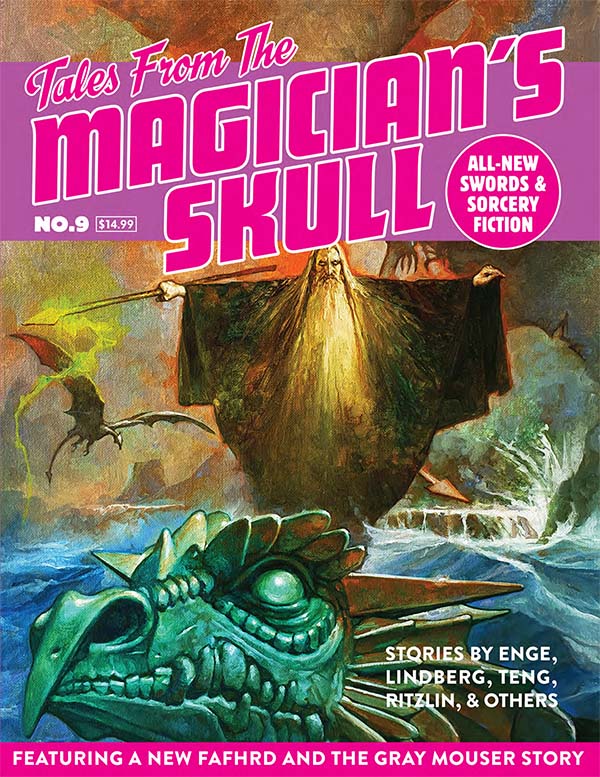
Tales from The Magician's Skull #9

Contributor copies just arrived.
Philip is so delighted to have a story feature in this great magazine.
"Seven new sword-and-sorcery stories from some of the top talent in the industry," I note it says.
Wednesday, 11 January 2023
When writing historical fiction, how important is it to get the history exactly right? (Quora)

Often, what we think of as history is mostly legend, primarily viewed through the eyes of prejudice, either favourable or unfavourable.
The Romantic Movement of the early 19th Century seriously distorted modern perspectives on various historical people and events. Their legends turned outlaws into heroes and discovered hitherto well-concealed hearts of gold beating in the breasts of black villains. The real Richard the Lionheart was a bad king. Rob Roy ran a protection racket. Quite a lot of people nowadays think the jury should still be out on whether the Princes in the Tower were murdered at all, let alone who murdered them.
A very big mistake is to attach a modern grievance to an imagined and highly embroidered ‘historic wrong’. Not only are we not our ancestors, we scarcely even know who our ancestors were, even when we know their names.
After the rise of nationalism in the Middle Ages, it became almost impossible to view the events that gave birth to nationalism without erroneously inferring that the effects were somehow self-contradictorily part of the cause. All over Europe, aristocrats and heroes who were probably mostly interested in their own power and security are today looked upon as fathers of their nations.
We also have a natural tendency to isolate our own country from the wider context and inflate people and events of local significance into towering giants. Then we wonder why the rest of the world hasn’t heard of them, and view their ignorance as somehow disrespectful.
This same near-sightedness also causes us to identify with ancient peoples who lived where we now live, even though they may have been swept away by history, leaving little behind for us to look at with wonder, and having no connection with us today except an accident of geography.
I would urge caution when writing about historical events in a manner designed to stir modern passions. You don’t know the truth. Even if you are trying to get at the truth, you aren’t going to succeed. Modern people don’t know the truth either. That means they may take your word for it. To precipitate modern events on supposed historical grounds would be bad enough even if you were right. If you are wrong, and worse, in some cases, not even trying to be right, or deliberately falsifying events, is not a good thing.
So write about imaginary people in reasonably-accurate historic settings, by all means. If you write about real people, even as background, be scrupulous. And if you must write about real people the way you would have liked them to be, rather than as justified by the best evidence, don’t be surprised if someone doesn’t like your work.
Tuesday, 10 January 2023
How do I argue for something I don't believe in? (Quora)

I cannot sufficiently stress how vital it is to be able to argue from your opponents’ position. To begin with, if you cannot anticipate their arguments, they will take you by surprise in the debate and embarrass you.If you cannot anticipate their arguments, you cannot prepare answers to their arguments in advance and have them ready when required.
And finally, how do you even know which side you are on, if you have never taken the trouble to learn why your opponents think differently? You will be incapable of rational decision because you have only ever heard one side of the case. You will have to resort to bluster and prejudice because you won’t be able to reason. This is not a good idea.
I draw your attention to the method by which Boris Johnson, former Prime Minister of the UK, decided which side of the Brexit argument he would choose. He wrote two articles, one explaining why we should remain in the EU, and one explaining why we should leave, and then compared them in order to discover which was the more persuasive. Some people attacked him over this for having no convictions; I thought, here at least, he displayed a preference for reason over emotion.
You should try this approach. It will be of lasting benefit.
Monday, 26 December 2022
Tales From The Magician's Skull #9
The Raven-Feeder’s Tower by Philip Brian Hall
The skeleton was held upright by a tall stake driven deep into the ground, to which support its spine was fixed by leather bonds. The breastplate covered bare white ribs and the helmet’s visor protected merely the empty eye-sockets of a morbidly-grinning skull.
I really like this story. I hope you do too.
Saturday, 17 December 2022
How do horses feel knowing that automotive has replaced them? Is it why they have this saddened face? (Quora)
Horses are just better at pageantry than motor vehicles, and tedious parades of mechanical weaponry are really best left to unimaginative foreign dictators who like that sort of thing, and to their oppressed subjects who seem to appreciate it..
Until well into the twentieth century the horse was integral to society. Specialised breeds of horses could do everything from pulling logs out of barely-accessible forestry plantations to carrying elegant ladies side-saddle on fashionable excursions down Rotten Row. Cavalry horses, well used, would regularly turn the tide of land battles, while draught horses transported everything, everywhere, including providing the source of power for canal barges during the Industrial Revolution. Plough horses were vital to agriculture; race horses provided a principal source of entertainment that enthralled everyone from dukes to dockers.
I once tried to illustrate some of the varieties of equestrian leisure in a cartoon:
But it is a mistake to conceive of a horse as having an extensive capacity for abstract thought. His world revolves around the food, stabling, exercise, care and attention that he receives from his owners or grooms. He has no trouble communicating his likes and dislikes in respect of that treatment. He knows whether he is treated well or neglected. He knows his rank in the domestic herd: he does not know how important his ancestors were to our ancestors. He knows if he is good at what he does, and he may well appreciate praise for a top class performance, but he does not know that the role of the horse in society has changed, is changing, and will continue to change.
So, while it may or may not be true that in a specific employment a machine might be more economical, to my mind, people who think that horses can always be replaced must be people who have never worked with horses.
And the reason a horse needs a long face should be obvious. This is Buster. He is not sad.

So, while it may or may not be true that in a specific employment a machine might be more economical, to my mind, people who think that horses can always be replaced must be people who have never worked with horses.
And the reason a horse needs a long face should be obvious. This is Buster. He is not sad.
Saturday, 19 November 2022
What did Socrates mean when he said "I know that I know nothing"? (Quora)

If, however, I start from the assumption that I know nothing, I may ask anyone who claims knowledge to explain a particular aspect of what it is that they know. Usually Socrates would invite his interlocutors to state a generally-applicable principle, and then he would offer a specific instance of the principle’s non-applicability. This would lead to the interlocutor redefining the principle more narrowly. The process would be repeated until it could be repeated no further, at which point Socrates would deem that they had arrived at a truth.
The process has considerable merit, but is inevitably limited in scope. Ironically, Donald Rumsfeld’s much-derided, but actually important, categorisation of knowledge into known knowns, known unknowns and unknown unknowns helps us to understand this.
Most people are aware that there are limitations to their knowledge (or known knowns); for them there exist known unknowns. So, for example, I am aware that there is a field of human knowledge called quantum mechanics, but I have no detailed understanding of what that field encompasses.
Unknown unknowns have been usefully defined as “phenomena which cannot be expected because there has been no prior experience or theoretical basis for expecting the phenomena”.
But in later life Rumsfeld came to acknowledge the existence of a further category, possibly the most problematical of all, that of unknown knowns. These he defined as "the things you think you know, that it turns out you did not".
Like Rick in Casablanca, we can be misinformed. Sadly, we may act upon mistaken beliefs with all the intensity that would ideally be reserved for genuine certainties.
So, if we return to Socrates, we find that even the little that we think we know may be just waiting for some counter-argument or evidence to turn up.
Saturday, 12 November 2022
Does Scotland really needs a referendum to get its independence? After all, they didn't need a referendum to join the union? (Quora)
Our island history is of a long series of ‘Unions’.
When Dalriada was united with Pictland to form Alba, was Alba one country or a union? When Alba was united with northern Northumbria to form Scotland, was Scotland one country or a union? When Northern Strathclyde was incorporated into Scotland, was the resulting country then a union? Likewise, when the Western and Northern Isles were incorporated into Scotland? Did each and every one of these former countries retain a right to secede?
Meanwhile further unions were taking place in the south to form a country called England out of countries called Wessex, Cornwall, Kent, Essex, Mercia, Northumbria, Rheged etc. Wales was the last piece to be fitted into this jigsaw.
I think it is quite important to mention these earlier amalgamations, because current discussions seem to take for granted that all of England is culturally the same, or that there is only one historic culture in Scotland.
Eventually the island consisted of only two kingdoms, each of which came first under the same rule, (effectively putting an end to border reiving, because malefactors could no longer flee from one king’s jurisdiction to the other’s), and then the two of them united together into one country called Great Britain.
What exactly is supposed to make the union, in 1707, of these two remaining kingdoms somehow different from all the unions between then-existing countries on this island that went before?
And incidentally, since both the formerly-divided former kingdoms of Northumbria and Strathclyde were at long last actually reunited in 1707, should we, as an alternative option, be offering a referendum to their residents to ascertain if they want to be split up again between their respective former owners?
A Political Parable

The most successful politicians will probably be ships. The most respected will usually be lighthouses.
Sadly, of course, whilst a ship may occasionally be blown on the rocks, a lot of lighthouses are on the rocks to start with!
Saturday, 17 September 2022
What are the advantages of "cancel culture"? (Quora)

Any public espousal of heterodox views will result in a torrent of threats and abuse. You will be reported to the authorities. You may be investigated by the police for committing a ‘non-crime hate incident’. Your employer will come under pressure to dismiss you. Your products or artworks will be boycotted simply because they are yours. You will be falsely portrayed as ‘whatever-it-is-phobic’ by people who do not understand the meaning of ‘phobia’.
In short, you will become an unperson, airbrushed from historic photographs, deleted from records and in all respects treated by bien-pensants as though you did not exist.
The advantages for the bien-pensants include:
1. You don’t have to bother engaging with what a cancelled person actually says. This saves a lot of mental effort.
2. You don’t need to come up with rational counter-arguments. This saves exposing your own limitations.
3. Once the thought-police have pronounced the cancelled person guilty, you don’t need any further evidence. A cancellation is good for all time, since it is well known that leopards never change their spots.
4. You are not exposed to any potentially disturbing suggestions that you might just conceivably be wrong.
5. The people upon whose behalf you take offence will appreciate your speaking up for them. And, if they don’t, they aren’t really proper victims at all but collaborators, and you can be rude to them without incurring the penalty of being cancelled yourself.
6. You get to invent neologisms and acronyms to use as insults towards the people you cancel. This enables you to make your mark on the world and enrich the language. (You should be careful to avoid looking in a dictionary to check for pre-existing words). You can display your erudition by using dead classical languages when making up these new words, even if you don’t actually know what words mean in dead classical languages, because no-one dare argue.
7. If you are a student, you can get rid of any teacher you don’t like or who gives you bad grades.
8. If you are a teacher you can threaten with cancellation any student who might have the potential to expose your ignorance or shortcomings.
9. You don’t need to trouble yourself to invent or create anything good. You could become famous simply for tearing things down.
10. You get to feel self-righteous, superior and smug.
11. You get to hate and be intolerant while still describing yourself as liberal. This gives you the best of both worlds.
12. And by the time anyone realises that nothing original and beneficial is coming out of the conformist and obsequious society you have created, you will be too old to care.
Tuesday, 16 August 2022
What is the reason that science fiction is considered "literature" despite the poor writing quality of much of it? (Quora answer)
Bad writing is not usually considered literature, no matter what its genre.
Science fiction writing, like writing in other genres, is only usually considered literature if it is good writing.
Most writing is bad writing. Some writing is good writing. Good writing is good writing no matter what its genre, though what makes writing good is not necessarily the same in all genres.
A writer who can’t write but enjoys writing is not all that different from someone who enjoys singing but can’t sing or who enjoys painting but can’t paint. If someone enjoys doing it, then the art has served a purpose. When someone enjoys reading what you have written, you have made an important step forward. Your close friends and relatives who tell you how good your writing is do not count.
In the modern age a lot of bad writing is self-published. Some good writing is self-published. Some bad writing is commercially published. Being commercially published is not proof that your work should be considered literature, but it’s a start.
The chances that someone will enjoy reading what you have written are better if your writing is good. The chances that your writing will be considered literature depend upon a whole host of other factors, but reader enjoyment is where everything starts.
Science fiction writing, like writing in other genres, is only usually considered literature if it is good writing.
Most writing is bad writing. Some writing is good writing. Good writing is good writing no matter what its genre, though what makes writing good is not necessarily the same in all genres.
A writer who can’t write but enjoys writing is not all that different from someone who enjoys singing but can’t sing or who enjoys painting but can’t paint. If someone enjoys doing it, then the art has served a purpose. When someone enjoys reading what you have written, you have made an important step forward. Your close friends and relatives who tell you how good your writing is do not count.
In the modern age a lot of bad writing is self-published. Some good writing is self-published. Some bad writing is commercially published. Being commercially published is not proof that your work should be considered literature, but it’s a start.
The chances that someone will enjoy reading what you have written are better if your writing is good. The chances that your writing will be considered literature depend upon a whole host of other factors, but reader enjoyment is where everything starts.
Sunday, 14 August 2022
The Protest Diaries

I did however submit two stories to 'Alternative War,' which appeared some months ago. Since the longer of those two stories, AWOL, made it into that volume, it may be that the shorter one was transferred in this direction. Or not.
Anyway, 'Interrogation for Beginners' is a story I like, and I hope you will like it too. As the title suggests, it concerns a veteran interrogator who has to take time out of his regular business to interview a new recruit who is still very wet behind the ears. I hope this inevitable culture clash may contain a few useful thoughts.
Protest is often about culture clashes. Sometimes we tend to support the protesters and sometimes our sympathies lie with the authorities. The point, in the case of this story, is that both the veteran and the recruit are on the same side; they just come from generations that differ over both ideals and methodology.
Can we achieve desirable change without fragmenting society? Eliminate the bad without destroying the good? Are youthful ideas best, or do they need tempering by the wisdom of age?
These are among the things that I hope we may be inspired to think about.
Friday, 1 July 2022

Thursday, 23 June 2022
4th and Starlight

A young lady grifter is determined to prove herself the equal of all the famous con-men in her family, but when she accepts a challenge to date a space alien, it becomes unclear who's doing the conning.
Join these rising stars of science fiction and fantasy at the corner of Fourth and Starlight for a journey like no other.
Step into a world ravaged by robotic warfare to explore buried secrets, visit with a sleep-deprived mermaid, and journey to ancient Egypt to romance a Mourning Woman. Chase down an outlaw with a jaded bounty hunter, play in the woods with a little boy and his friend, or ride along on a haunted food truck. Let go of grief at the airport, flirt with a succubus, and survive a spaceship crash with a cyborg. Nineteen stories that will fill you with delight, inspire your imagination, get your heart pounding, and leave you misty-eyed with joy.
Stories by Mike Wyant Jr., K.L. Shwengel, Kary English, Philip Brian Hall, Rebecca Birch, Van Alrik, Kristy Evangelista, Preston Dennett, Dustin Adams, Y.M. Pang, M. Elizabeth Ticknor, Rebecca E. Treasure, Alicia Cay, Julia Ashley, John D. Payne, Rachelle Harp, and Dr. Robert Finegold.
Subscribe to:
Posts (Atom)