Showing posts with label Burgundy. Show all posts

Saturday, 28 November 2015

Chalon-sur-Saone

I suspect I have spent considerably more time in tour buses than in chauffeur-driven limousines.  Yet sometimes it's the rarity of things that makes them enjoyable. In the case of our airport transfer from Lyon to Chalon I have to say that Scenic did us proud. As a result of arriving quite early at the riverboat that was to be our home for the journey to the south of France, we had time for unguided wandering around the town, discovering some of its interesting features for ourselves.


Chalon owes its foundation to a conjunction of navigable river and major roads, though the road may have been more important to the Romans than to later ages since it pointed straight towards a vulnerable frontier.  

Nevertheless there are still picturesque sights that remind you of what the medieval town must have been like.  Here on the right is a photograph of the corner of Rue du Pont and Rue du Chatelet for example. For some reason this sort of thing does not sneak into the usual tourist snaps.

What does sneak in is the history of photography itself, because Chalon was the home of the inventor Nicéphore Niépce who, in addition to pioneering the internal combustion engine a half century or more before the people who became famous for it, also produced the first photographic image, even if it was a negative and he had trouble stabilising it.

The Cathedral of St Vincent has origins in the 8th century though it is the 19th century neo-Gothic facade that attract the photographers.

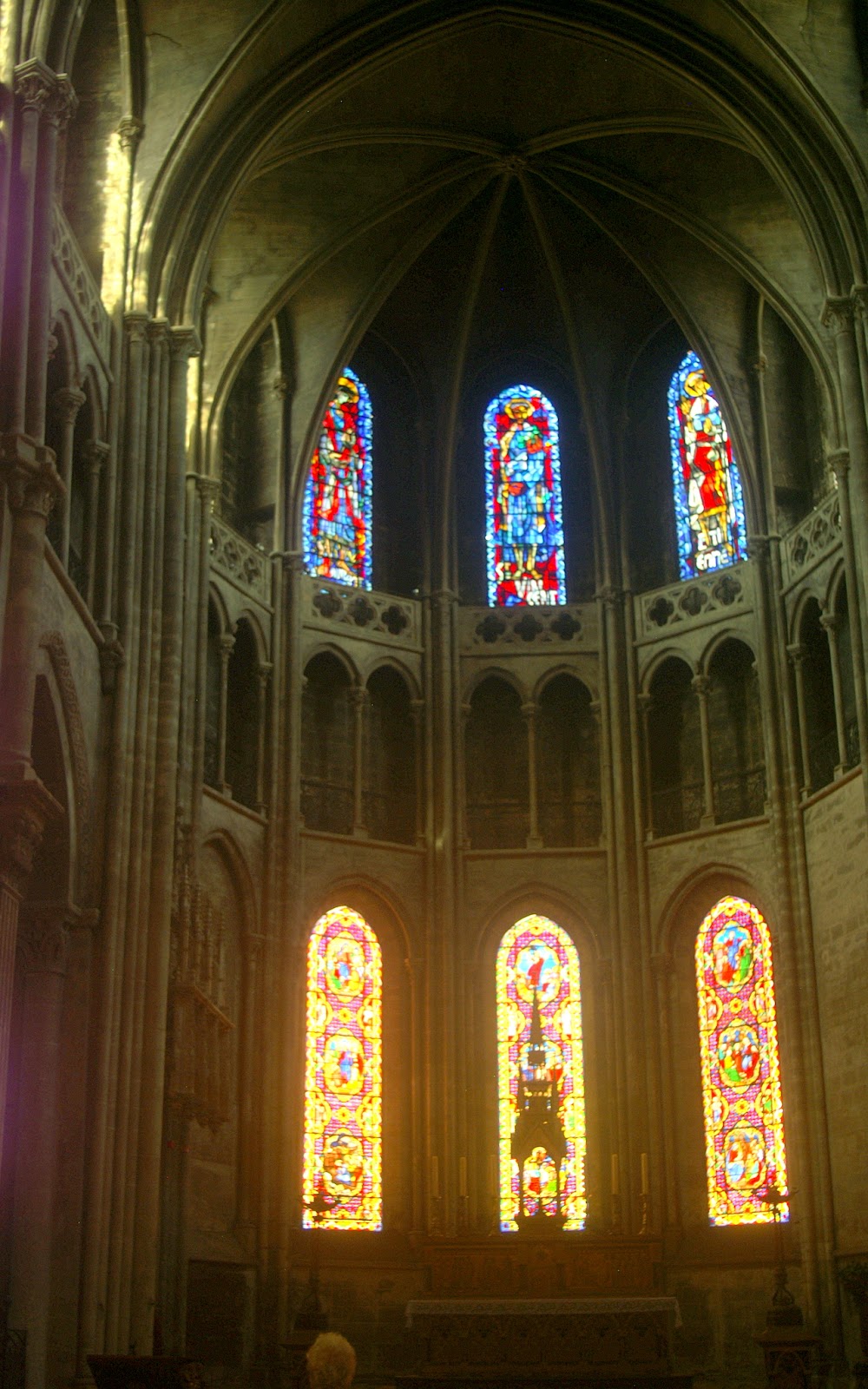
Inside (left) you can see the beautiful stained glass of the apse, which is still divided into three storeys so that the blindstorey and clerestory carry on right around the church.

I was busy experimenting with my new (to me) 28mm f.2.8 Ensinor lens, which turned out to be capable of pretty decent flashless indoor photographs once I got the hang of it. It certainly conveys the atmosphere of St Vincent's quite well.

I know it's selfish but I find the more commonly visited cathedrals harder to appreciate because the crowds leave so little of the reverent atmosphere and demand such an effort of concentration. Here there wasn't a lot of distraction.

Another interesting feature of Chalon turned out to be trompe-l'oeil decoration on buildings. The one on the left is perhaps a little faded, but certainly it could almost be a real flight of steps leading up to a real statue.  Maybe the artist has made the steps rather too steep and the statue too big, but it's still impressive.

Elsewhere you need to do a double take to check whether the person looking out of a window is a real person (and a real window).

But like any riverside town it is the river itself that dominates the local scene. Writing under grey, rainy skies in late November it is almost incredible to recall that we managed to visit Burgundy just as a heatwave arrived in France.

We aren't always gifted with such prescient organisation!

Wednesday, 9 September 2015

The ruins of Cluny

What is left of Cluny is worth seeing, if only for the formidable effort of imagination that it demands of you.

Until the construction of the new St Peter's, Rome, during the Renaissance, Cluny Abbey was the world's largest church. It is believed that the Pope sent a delegation with specific instructions to measure the length of Cluny's nave so that St Peter's could be larger, since that was only appropriate for the premier church of Christendom.

Mind you this was presumably the same Pope who also authorised the demolition of parts of the Colosseum to provide a source of cheap marble for St Peter's.

In its heyday Cluny was the mother house of monastic institutions all over Europe. These Cluniac houses were mostly priories, not abbeys, because they owed allegiance to their Abbot in Burgundy and the priors of the satellite houses travelled once a year to confer at the gigantic centre of the monastic world.

After the French Revolution, Cluny suffered an even worse fate than Vespasian's grand arena. Sold to a stone mason it was almost completely razed to the ground; only the tower adjacent to the cloister was saved, and that not from any sense of the building's historic significance. Merchants who had turned the cloister (left) into a shopping mall were concerned that any attempt to demolish the final tower would risk the destruction of their business premises along with it.


In a year when we mourn the devastation of remnants of ancient civilisations in the Middle Eastern war zone, it is as well to remember that the urge to do away with monuments to a culture with which we have no sympathy is a recurring blight on the human race and no new invention.

The blowing up of the Parthenon in 1687 and the careless burning of Linlithgow Palace (close to Sliabh Mannan) in 1746 are two more examples. 

And in case we think we in the civilsed West are now immune to the Vandal mentality, perhaps we should consider why it was only this year, seventy years after the end of the Second World War, that a decision could be taken about what to do with the remains of Speer's Nazi rally arena at Nuremburg.

We do not have to agree with the religious or political philosophy that underpinned a historic monument in order to wish to preserve it. We learn about ourselves by learning about our ancestors and there are few better ways than having the opportunity to consider what they built and what marks they left upon the physical world.


Friday, 4 September 2015

Pérouges - a living film set

Pérouges is a small, walled medieval town in Ain, France.

A century or so ago it almost died after the re-routing of road and rail connections left it isolated from the currents of modern life. It seemed that fortified hilltops were no longer required in the twentieth century.

Depending on your source you may find that the population, never much greater than 1,500, had declined either to 90 persons or to a single family.

I am not sure whether these two statistics are mutually exclusive; I suppose it might depend on how you define family.

In its heyday Pérouges was known for hemp weaving. The name suggests that it was founded by Gallic colonists returning from Perugia in Italy, but the name is older than the town, since it applied to a noble's home which was successfully defended against the local bishop in the early middle ages.

The town was later successfully defended against a French siege, not ultimately becoming part of France until 1601.

It is so well preserved that it is used for shooting period films such as The Three Musketeers. However it is really only the fabric that is medieval. There are no chickens or pigs in the streets, no sewage runs down the middle of the roads and the unwary photographer may even find the odd motor car sneaking into his pictures on the outskirts of the town.


But if you want to see a beautifully kept set of medieval buildings, give or take the odd relatively modern window, there can be few better places to go. Even the church is built into the fortifications and the central square with its beautiful inn is a good place to purchase a restorative after a walking tour.