Showing posts with label river. Show all posts

Friday, 15 July 2016

Bordeaux Waterfront by Night

For several years I have been interested in the problems of photographing a nocturnal illuminated waterfront from the deck of a ship. I made my first efforts in Gibraltar and Livorno from the deck of the cruise liner Boudicca.  I tried again on the Danube and in Dubrovnik. My most recent efforts were on the Rhone / Saone last year.

Many of the results had certain aesthetic qualities, but sharpness was rarely amongst these. This year I owe a special vote of thanks to the two captains of the Scenic Diamond. They contrived to balance their vessel almost motionless between the current and the tide, providing a remarkably stable platform for photographers.

I set up my travelling tripod and cable remote for the shutter of my new (to  me) Sony A580. For once I did not mess up my choice of settings. The result was a series of photographs that were pretty satisfactory directly from the camera.

The main features of the photographs are the palatial frontage of Place de la Bourse and the many stone arches of the Pont de Pierre. Throw in the spires of the cathedral and other churches, streetlights and beautiful reflections on the surface of the River Garonne and you have a captivating set of ingredients for magical evening scenes.


Saturday, 28 November 2015

Chalon-sur-Saone

I suspect I have spent considerably more time in tour buses than in chauffeur-driven limousines.  Yet sometimes it's the rarity of things that makes them enjoyable. In the case of our airport transfer from Lyon to Chalon I have to say that Scenic did us proud. As a result of arriving quite early at the riverboat that was to be our home for the journey to the south of France, we had time for unguided wandering around the town, discovering some of its interesting features for ourselves.


Chalon owes its foundation to a conjunction of navigable river and major roads, though the road may have been more important to the Romans than to later ages since it pointed straight towards a vulnerable frontier.  

Nevertheless there are still picturesque sights that remind you of what the medieval town must have been like.  Here on the right is a photograph of the corner of Rue du Pont and Rue du Chatelet for example. For some reason this sort of thing does not sneak into the usual tourist snaps.

What does sneak in is the history of photography itself, because Chalon was the home of the inventor Nicéphore Niépce who, in addition to pioneering the internal combustion engine a half century or more before the people who became famous for it, also produced the first photographic image, even if it was a negative and he had trouble stabilising it.


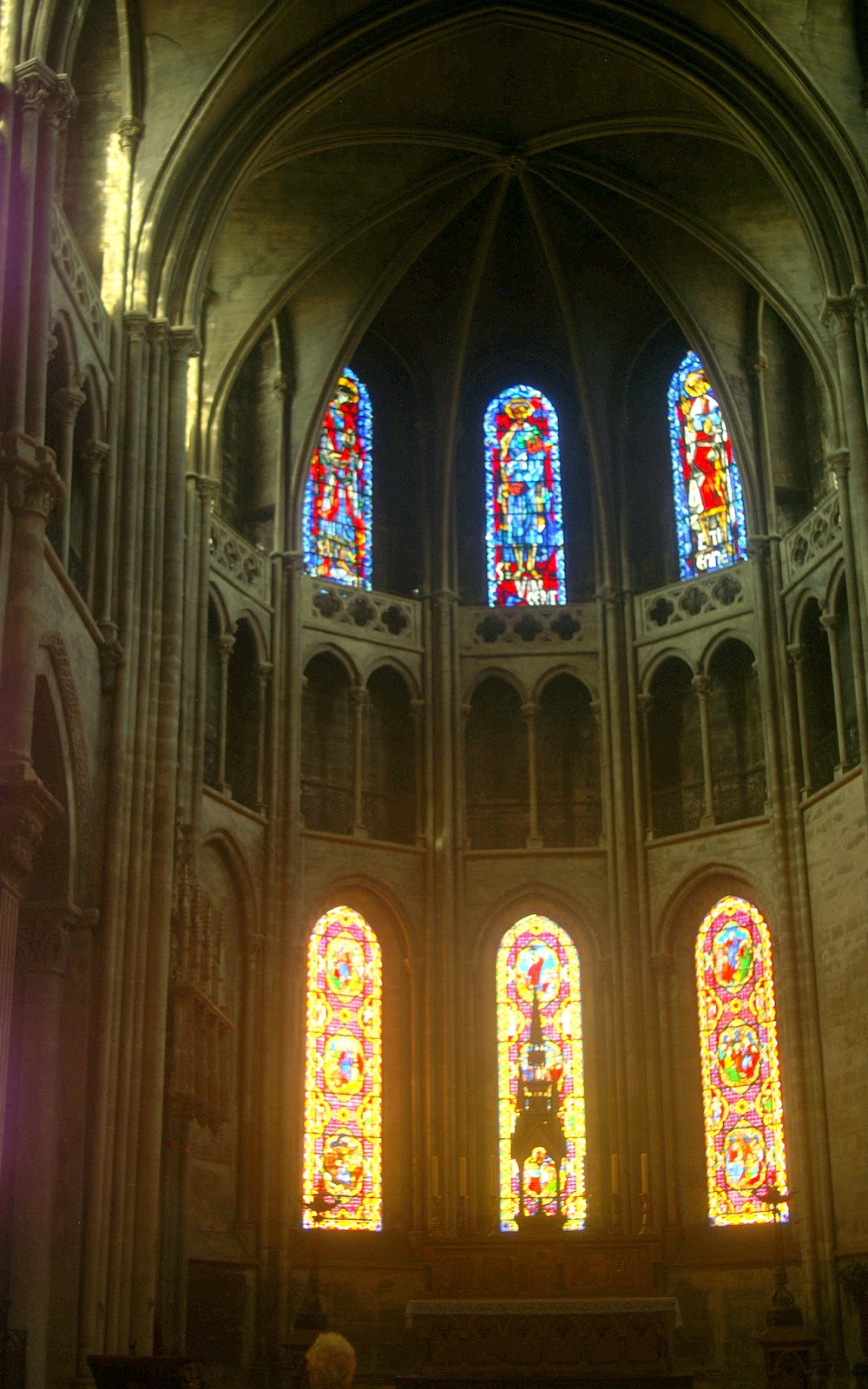
The Cathedral of St Vincent has origins in the 8th century though it is the 19th century neo-Gothic facade that attract the photographers.

Inside (left) you can see the beautiful stained glass of the apse, which is still divided into three storeys so that the blindstorey and clerestory carry on right around the church.

I was busy experimenting with my new (to me) 28mm f.2.8 Ensinor lens, which turned out to be capable of pretty decent flashless indoor photographs once I got the hang of it. It certainly conveys the atmosphere of St Vincent's quite well.

I know it's selfish but I find the more commonly visited cathedrals harder to appreciate because the crowds leave so little of the reverent atmosphere and demand such an effort of concentration. Here there wasn't a lot of distraction.

Another interesting feature of Chalon turned out to be trompe-l'oeil decoration on buildings. The one on the left is perhaps a little faded, but certainly it could almost be a real flight of steps leading up to a real statue.  Maybe the artist has made the steps rather too steep and the statue too big, but it's still impressive.

Elsewhere you need to do a double take to check whether the person looking out of a window is a real person (and a real window).

But like any riverside town it is the river itself that dominates the local scene. Writing under grey, rainy skies in late November it is almost incredible to recall that we managed to visit Burgundy just as a heatwave arrived in France.

We aren't always gifted with such prescient organisation!

Wednesday, 12 August 2015

The Ardèche Gorge - where we touch prehistory


North of Avignon, the Ardèche River, which gives its name to the whole region, finally reaches the Rhone.  Before it does so it carves its way through limestone crags up to 1,000 feet high, forming the largest natural canyon in Europe (left).

On another day I might have liked to join those brave members of our group who took on the challenge of canoeing down the gorge.  It may or may not be the case that the 'other day' referred to was a score or more years ago.


I contented myself with the slightly less strenuous task of descending (and of course subsequently ascending again) the innumerable steps that form the path down to Grottes de St-Marcel d’Ardèche.  This is not the famous Grotte Chauvet, discovered in 1994, where the walls are home to the art of our distant ancestors of thirty millennia ago.  For obvious reasons that is not open to the public. Nor is St Marcel the recently opened replica cave.  It does however, for the truly desperate, include a reproduction cave painting (right).


Far more impressive is the remarkable natural architecture of the caverns themselves.  Rimstone pools, stalagmites, stalactites and imaginatively titled sculptures created over centuries by the action of water upon the living rock.


Even amid a heatwave, the underground chambers are cool and relatively quiet, although for those who like that sort of thing you can enjoy a son-et-lumière show at the rock waterfall (above).

The most famous natural landmark of the Ardèche Gorge is Vallon Pont d’Arc where the river has undercut the cliff forming a great natural bridge. Sadly there are things that you simply cannot do on a day trip, except perhaps in the mind's eye.