Showing posts with label France. Show all posts

Monday, 15 August 2016

Sauternes and Chateau Myrat

 Sauternes used to be thought of as purely a dessert wine, though in practice it is more versatile.  It can be paired well with local savoury products such as foie gras.

The region lies about 40km south of Bordeaux around the confluence of the Ciron and The Garonne.

It was explained to us that the Ciron maintains a lower temperature than the larger river. In summer the mixing of the two waters produces an evening mist the sun does not burn away until the middle of the next day.

The mist is conducive to the formation of Botrytis cinerea or noble rot, a type of fungal infection. The sun-drying in the afternoons however prevents decay. The result is a wizened or raisin-like grape which has far less moisture than normal but far higher sugar content.


All of this means the Sauternes harvest tends to be late, somewhat variable in quality, more vulnerable than normal to weather volatility and expensive because volume is low relative the amount of labour required.

The wine ages well, progressively darkening in colour as it does so, from blonde through honey to copper (right). It is said the taste develops in sophistication. Unfortunately I am no longer convinced that my wine cellar holds a sufficiently constant temperature all year round, so I shan't risk it for too long.


Probably the most famous of the Sauternes estates is Chateau d'Yquem (left). Jefferson records that, after tasting its product, Washington promptly ordered thirty dozen bottles. Possibly some multi-millionaires still do. I'm not quite that rich, unfortunately.

For myself I was completely delighted with the wine of Chateau Myrat (above and top left). I believe I was heard to declare that it was so superior to anything of the same appellation I'd tasted before that none of the latter could possibly have been real Sauternes.

Tuesday, 2 August 2016

The Wines of Bordeaux


Our 2016 cruise took us on three rivers, but covered relatively little total distance,

From Bordeaux we sailed up the Garonne as far as Cadillac, whence we returned to the confluence where the Garonne joins the Dordogne and together they form the Gironde. Down the estuary we went as far as Pauillac, up the Dordogne to Libourne and eventually back to the Garonne and Bordeaux.

Of the numerous wine terroirs in the region we were able to visit Medoc, Sauternes, St Emilion, Blaye and Cognac for tastings and others to view the scenery, historic buildings and cultural events. Some other local wines were available to accompany on board meals.

As a result I have a far better understanding of  this area and its wines than I did before, though I am bound to confess that is not saying a lot. Over the course of the next few weeks I shall try to describe some of the highlights. The low lights are perhaps best left in obscurity.

I've already posted several photographs of a magical nocturnal cruise along the Bordeaux waterfront, so I'll close this introduction with a panoramic view over the beautiful valley of the Dordogne.

Saturday, 14 November 2015

Pour La Liberté


Allons enfants de la patrie,
Le jour de gloire est arrivé!
Contre nous de la tyrannie
L'etendard sanglant est levé!
Entendez-vous dans les campagnes,
Mugir ces féroces soldats?
Ils viennent jusque dans nos bras
Égorger nos fils, nos compagnes!
Aux armes, citoyens!
Formez vos bataillons!
Marchons! Marchons!
Qu'un sang impur
Abreuve nos sillons!


Vive La France!

Sunday, 11 October 2015

Prospect of Lyon


Sometimes a holiday picture is just perfect. Take a picturesque setting, ideally including a river, some trees, a hill and some attractive buildings, throw in a good camera and a lot of luck, and on rare occasions it comes out like this.

This is the River Rhone as it flows through Lyon in central France. Although it shows big, bustling city, it almost contrives to convey a placid ambience such as you might expect to find in a Constable painting of rural England.

Never mind that this particular photographer takes hundreds of shots in the attempt to get one that comes out like this. No artistic genius is being claimed.

It's just lovely when it all works out right.

Friday, 4 September 2015

Pérouges - a living film set

Pérouges is a small, walled medieval town in Ain, France.

A century or so ago it almost died after the re-routing of road and rail connections left it isolated from the currents of modern life. It seemed that fortified hilltops were no longer required in the twentieth century.

Depending on your source you may find that the population, never much greater than 1,500, had declined either to 90 persons or to a single family.

I am not sure whether these two statistics are mutually exclusive; I suppose it might depend on how you define family.

In its heyday Pérouges was known for hemp weaving. The name suggests that it was founded by Gallic colonists returning from Perugia in Italy, but the name is older than the town, since it applied to a noble's home which was successfully defended against the local bishop in the early middle ages.

The town was later successfully defended against a French siege, not ultimately becoming part of France until 1601.

It is so well preserved that it is used for shooting period films such as The Three Musketeers. However it is really only the fabric that is medieval. There are no chickens or pigs in the streets, no sewage runs down the middle of the roads and the unwary photographer may even find the odd motor car sneaking into his pictures on the outskirts of the town.


But if you want to see a beautifully kept set of medieval buildings, give or take the odd relatively modern window, there can be few better places to go. Even the church is built into the fortifications and the central square with its beautiful inn is a good place to purchase a restorative after a walking tour.


Tuesday, 18 August 2015

Viviers - where time almost stops


Viviers is a rare exception to the seemingly universal rule that equates all change with progress. Here on the right bank of the Rhone the past threw up its defences against the encroachment of modernity and held the line, just as the resolute residents of the cathedral district once held the line against unruly soldiery quartered in the lower town.

Both parts of the medieval town remain mostly intact; if you want to buy a house here you can do so cheaply, but along with the medieval dwelling you take on the responsibility of history and a duty to preserve external appearances. Among the narrow streets houses press close upon each other as if for mutual support. Possibly the residents need the same, since many houses now stand empty. It seems it is more romantic to contemplate the simplicity of medieval life than actually to experience it. Nowadays not many folk have the option to stable their cattle on the ground floor in order to provide winter central heating; they'd prefer something a trifle more up to date.

The grandest house in the old town, known as La Maison des Chevaliers  (right), has a Renaissance frontage added in 1546 by an enigmatic local character called Noël Albert. This well to do salt merchant converted to Protestantism in order to escape condemnation for fraudulent tax-farming. During the wars of religion he sacked the cathedral but was later captured and executed after the Huguenot defeat.

It is suggested that the distinctly different quality exhibited by the two stone friezes of jousting on the house's frontage are accounted for by the fact that one was carved by a master-mason and one by his apprentice.

Our party was most fortunate to hear an organ recital in St Vincent's Cathedral by the celebrated Valéry Imbernon. We were joined by a ginger cat who strode down the aisle as though he was at home, which he may well have been.


Inside the cathedral the fine acoustics enhanced the experience, which was closed by a rousing rendition of the Marseillaise. The organist and our guide were the only French people there. Nevertheless it was a moving moment when the whole audience stood and some even managed to sing the words.

"For liberty," is a rallying cry as vital today as it has ever been.

Sunday, 16 August 2015

Châteauneuf-du-Pape - the wine of the Popes

Mention Châteauneuf-du-Pape to any lover of wine and he is likely to tell you immediately that it is a famous red wine of the south of France. What he probably will not tell you is that one Châteauneuf can be quite unlike another because in theory eighteen different varieties of grape may legally be used in its production.

In practice Grenache Noir accounts for almost three quarters of the vineyard area of Châteauneuf, with Syrah and Mourvèdre making up the great majority of the remainder. Nevertheless each vigneron still blends the wine to his own satisfaction. Having looked forward to my visit without understanding these facts, I was very surprised to find that wines of the same vintage can range from the frankly quite ordinary and disappointing to the really rather special. Of course your taste (and wallet) may easily vary from mine and therefore my best advice would be to try several and when you find the one that suits you best, stick with it.

Perhaps surprisingly in view of this diversity, Châteauneuf was actually the first of the Appellation Contrôlée rules in France and all vignerons within the region (about 3200 hectares) are subject to strict rules about what they can and cannot do.

The most remarkable thing I found was vines growing in what appears to be a glacial moraine. We were consistently told on our tour that the vines need to be stressed in order to produce the best grapes, pushing their roots deep into the soil in search of moisture. Well, I have to say I have seldom seen anything that looked less like soil than the acres of galets roulés or big round pebbles of the vineyard we visited. It seems the stones retain the heat of the sun and keep the vines warm at night, enabling earlier ripening. Well that's what they tell you anyway. This is certainly an unusual terroir.

What nobody tells you is that the village has only officially been Châteauneuf du Pape since 1893, though it was informally so called for centuries. Interestingly, it was already Châteauneuf (Newcastle) before Pope John XXII ordered the construction of the castle whose ruins now dominate the town. This construction was undertaken during the Avignon Papacy, though in practice the Avignon popes made little use of the castle until after the 1378 schism.

Like many another medieval building the castle became a stone quarry for subsequent generations.. During the Second World War it suffered the additional misfortune of being blown up by the retreating Germans.

But in this case we're really here for the wine.


Wednesday, 12 August 2015

The Ardèche Gorge - where we touch prehistory


North of Avignon, the Ardèche River, which gives its name to the whole region, finally reaches the Rhone.  Before it does so it carves its way through limestone crags up to 1,000 feet high, forming the largest natural canyon in Europe (left).

On another day I might have liked to join those brave members of our group who took on the challenge of canoeing down the gorge.  It may or may not be the case that the 'other day' referred to was a score or more years ago.


I contented myself with the slightly less strenuous task of descending (and of course subsequently ascending again) the innumerable steps that form the path down to Grottes de St-Marcel d’Ardèche.  This is not the famous Grotte Chauvet, discovered in 1994, where the walls are home to the art of our distant ancestors of thirty millennia ago.  For obvious reasons that is not open to the public. Nor is St Marcel the recently opened replica cave.  It does however, for the truly desperate, include a reproduction cave painting (right).


Far more impressive is the remarkable natural architecture of the caverns themselves.  Rimstone pools, stalagmites, stalactites and imaginatively titled sculptures created over centuries by the action of water upon the living rock.


Even amid a heatwave, the underground chambers are cool and relatively quiet, although for those who like that sort of thing you can enjoy a son-et-lumière show at the rock waterfall (above).

The most famous natural landmark of the Ardèche Gorge is Vallon Pont d’Arc where the river has undercut the cliff forming a great natural bridge. Sadly there are things that you simply cannot do on a day trip, except perhaps in the mind's eye.

Monday, 10 August 2015

The Vivarais Railway


Sometimes called Le Train de l'Ardèche, the metre gauge tourist railway running up the gorge of the Doux River is a great tourist attraction of Southern France.


In summer, visitors can ride in open sided carriages, the traditional rolling stock (left) being reserved for times when more  weather protection is required.

Closed in the 1960's, like so many rural lines in the UK, the line was promptly re-opened as a heritage railway and though it struggled for funds for a few years in this century it is now going strong again.

Part of the problem, our guide informed us, had been the cost of sharing the last kilometre of the route into Tournon with SNCF (the French  national railway.) To get around this the enthusiasts constructed a new station just outside the town at Saint-Jean-de-Muzols.


From there the train makes a daily round trip to Boucieu-le-Roi, a distance of about ten miles through some spectacular scenery, hugging the side of the gorge and looking down on the river far below. 

At the terminus the engine is shunted on to a turntable where the fireman (right) is able to display a combination of muscle power and superb engineering as he switches the direction of the engine without any power source but himself!


Because of the sharper than usual curves necessitated by the terrain, the steam locomotive is articulated according to the Mallet design. This means that what looks like a single 0-8-0 set of driving wheels beneath the engine is actually two in a  0-4-4-0 layout, the front set being mounted on a separate bogie which is able to turn independently of the main frame. 

The front set of wheels is driven by the second stage of the compound steam engine's power output.


Tuesday, 4 August 2015

Sous le Pont d'Avignon


The Bridge at Avignon (above) is famous because of a popular song, but in olden times it was important for far more serious reasons.

The only fixed bridge over the Rhone south of Lyons, in the early Middle Ages Avignon Bridge marked the boundary between the Papal State (Comtat Venaissin) and France. From 1309 to 1377 Avignon was the official residence of the Pope and a great palace (right and bottom) was built there. (This period should not be confused with the Schism of 1378 after which there were two men claiming to be pope, one of whom resided at Avignon and the other in Rome.)

Relations with France were not necessarily friendly in the early years of the Avignon Papacy.   Later French influence grew. The Bridge was guarded and fortified by both sides, though at some stage apparently song and dance parties were held on an island which formed the base of some of the bridge's great stone piers. What appears to be the far bank of the Rhone in the photograph below left is actually a large island; there is a further channel beyond which is not visible.  So the song has it wrong, the dancing was sous and not sur le pont.

The papal era bridge had 22 stone arches, but was vulnerable to damage by the Rhone's powerful floods which would sweep away some sections. It appears temporary patches were made with wood, but after being finally abandoned in the 17th century much of the bridge was demolished or swept away, so that now only four arches remain, into one of which the Chapel of St Nicholas is built.

Modern archaeology has discovered Roman foundations and radiocarbon dating suggests that a Gallo-Roman bridge may have existed for a time between 290 and 530 AD.

The canonised shepherd boy Saint Bénézet inspired the building of a bridge in the 12th century by miraculously lifting a huge stone. He was originally interred in the St Nicholas Chapel on the bridge itself. After the abandonment of the bridge, his relics were removed to the Hôpital du Pont on the Avignon side. Saint Bénézet's original bridge was destroyed during the Albigensian Crusade, when the Cathar Heresy (so-called) was extirpated in Provence.


Wednesday, 29 July 2015

Arles

One hundred and twenty five years ago today, Vincent Van Gogh died.

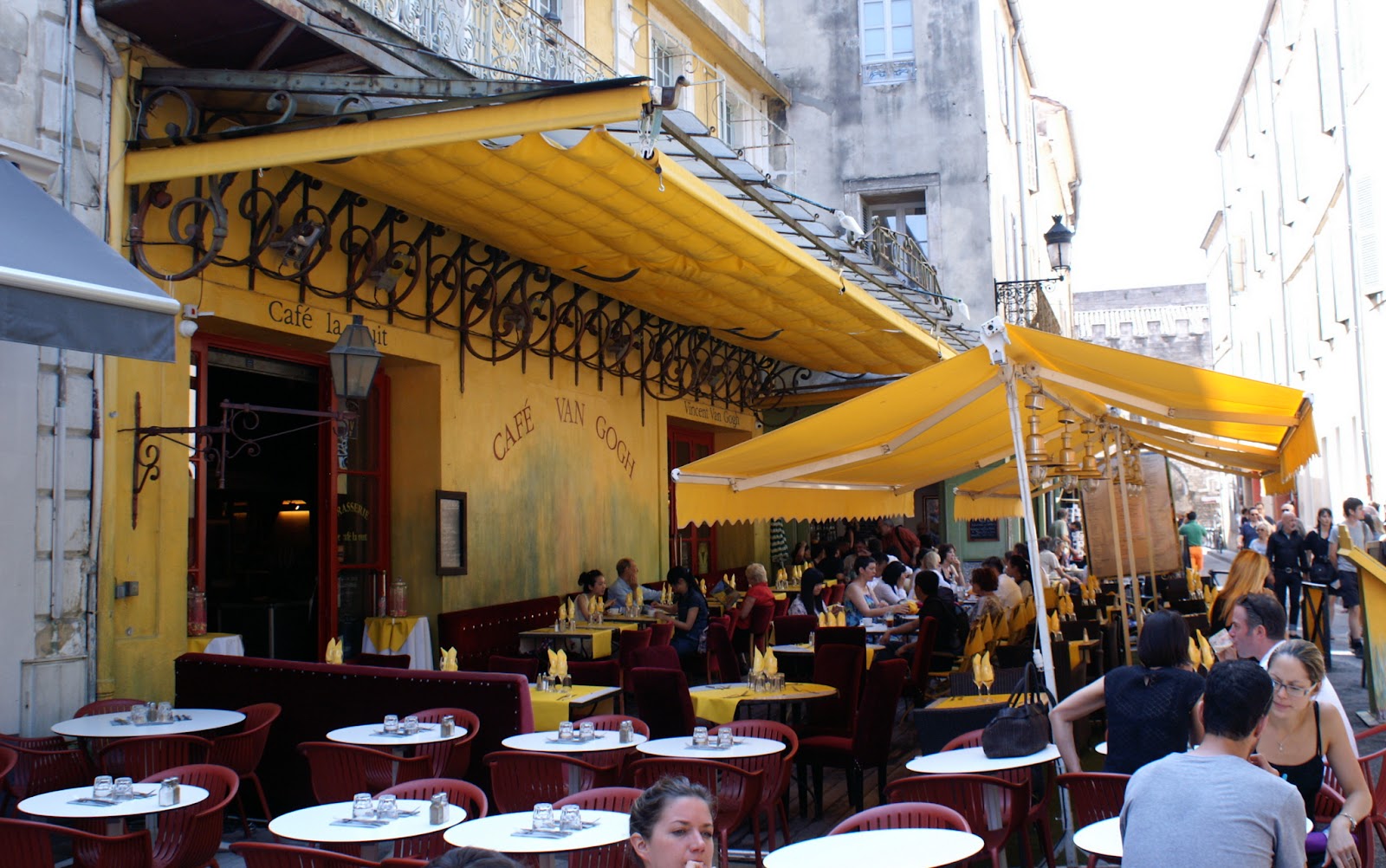
Of the three sites in Arles most associated with him one, The Yellow House, was destroyed during the Second World War but The Hospital (left) and The Night Cafe (below) can still be visited today. Appropriately the latter is still painted yellow. I was not able to photograph it at night, but my picture was taken from a not totally dissimilar angle to that of the painting.


The Van Gogh connection is not the only reason to visit Arles.  I was unprepared for the remarkable state of preservation of the Roman Amphitheatre, which is today still in use for bull fighting (with Spanish bulls) and the racing games featuring the smaller Camargue bulls.

Though much smaller than the Roman Colosseum, the Arles amphitheatre has suffered less depradation by builders looking for a cheap stione quarry.  This was because it served as a fortress on the bank of the Rhone (below)  and was able to contribute to the defences of the town.

Considerably less grand are the late Roman Empire baths, the contrast between the two clearly evocative of the decline of Roman civilsation, even if the latter was the work of Constantine.

Arles was frequently a Roman headquarters and briefly a usurper capital.  It is also known as an early site of the religious conflict between Rome's Catholicism and the Arianism of the Visigoths, the independence of the latter no doubt being strengthened by the local traditions originating from Les-Saintes-Maries-de-la-Mer not far to the south.

The Emperor Barbarossa was crowned here in the 12th century, but Arles' importance declined as that of Marseilles grew. Today, perhaps especially today, it is probably best known for its association with Van Gogh.

Saturday, 25 July 2015

Les-Saintes-Maries-de-la-Mer, Camargue

According to legend, a party of disciples fleeing persecution in Judah shortly after the crucifixion sailed to the south of what is now France and landed in the location of the present town of Les-Saintes-Maries-de-la-Mer. The refugees included the three Marys: Magdalen, Salome and the mother of James, along with Martha of Bethany and Joseph of Arimathea.

In the Camargue, no-one would entertain the notion that this story is not literally true. Though the whereabouts of the Magdalen's remains are disputed, everyone knows that Salome and the mother of James are buried in Les-Saintes-Maries-de-la-Mer (above right) and Martha in Tarascon (below left). It is unthinkable that the popular medieval competition between shrines to rediscover relics of saints in order to attract pilgrims, the medieval equivalent of tourists, had anything to do with it.

Even leaving aside the question of relics, the association of Mary Magdalen with the area has very strong traditional roots. It was of course a part of the old story on which The Da Vinci Code was built. The Albigensian Heresy (Catharism) in the early middle ages, and the 19th / 20th century mystery of Rennes-le-Château have also some possible links to the story.

Today these churches are still places of pilgrimage, and 
Les-Saintes-Maries-de-la-Mer is the site of an annual Roma pilgrimage in honour of their patron St Sarah, whose relationship to the ship of refugees is not entirely clear.  She may have been a servant or a local woman who welcomed them.

The strength of feeling that surrounds these places is entirely convincing to romantics like me.

Monday, 20 July 2015

Pont de Gau, Camargue

I could happily spend all day in a bird reserve. Since I know myself only too well I took careful measures to be back on time on this occasion, though I needn't have worried because another keen bird photographer was late back to the bus instead of me.

The salt marshes of The Camargue are full of exotic species; wild birds being encouraged to congregate inside the bounds of Pont de Gau by feeding. The Greater Flamingos cluster in garrulous flocks close to the shore of  small lakes, demonstrating by their high stepping strutting that the water is only inches deep and especially convenient for their strange but logical method of sieving the oozy mud below through odd-shaped beaks.

Other species are slightly less gregarious. Greater Egrets seem to have slightly more respect for each other's personal space and roost several feet apart. Yellow-crested Cattle Egrets seem to mix in with their all-white relatives without concern, and even the often solitary grey herons will join the family groups.

It is quite hard to take a bad photograph where large birds are so concentrated. After some time photographing birds on the ground, I decided that take-off and landing presented greater challenges, though my attempts here also caused me to waste many more exposures. It is so easy to have the wrong depth of field and end up with part of a bird out of focus. If it happens to be the head that you have wrong this will ruin the shot, yet the recommended technique of focussing on the bird's eye is remarkably difficult if the bird is moving.

You need good reflexes and a steady hand; I was usually quite pleased just to get the whole bird in the frame. The White Stork on the left obligingly assisted by coming in to touch down in just the right spot.

There are lots of tracks around the lakes of Pont de Gau and it is easy to find yourself on your own, even when there are crowds around the cafe and enclosures. 

For any naturalist in The Camargue, a visit to Pont de Gau should certainly be on the agenda.  Take several lenses, spare batteries and lots of time.  Oh, and if it's a still day, take mosquito repellent!


Sunday, 19 July 2015

White Horses of The Camargue

Many of us dream of visiting the Rhone delta, the sparsely populated area of southern France known as The Camargue. Like many other dreamers,  I imagined I was going to take lots of photographs of lovely white horses running out of the surf.

Truth to tell, that sort of picture has to be staged for the photographers by the traditional cowboys of The Camargue. The horses do not actually spend their time playing on the beach. Why would they?

So unless you're very lucky, you have to make do with a misty photograph of grazing horses taken through the window of a tour bus. A bit like the one on the left.

The most important town of the region, Les Saintes Maries de la Mer, of which I hope to write more later, has an off season population of below 3,000 but a summer population of 50,000.  There see to be innumerable  trekking establishments where you can ride the white horses amongst the salt marshes, winding your way between the many lakes and observing the fascinating wildlife.

To a person from northern latitudes, egrets and flamingos count as exotic, so it is astonishing to see the wild birds that flock to the reserve at Pont de Gau. I hope to write at greater length about that wonderful place too.

For now, however, I have still my dreams about what Camargue might have been like, if only I had been on my own and not surrounded by a crowd of other tourists such as myself!