Saturday, 22 November 2014

Goodbye Buster


Foaled 1989 died 22 November 2014.

I bought Buster at auction in 1993 with the last bid I could afford. He was my riding club horse as well as a point to point racehorse. He was in professional training with three different trainers and twice placed third in novice steeplechases over two miles before his impoverished owner ran out of the wherewithal to pay training fees.

He remained in good health to the last, having almost miraculously recovered from a stroke a few years ago that initially almost paralysed his near hind leg. Just a few days ago we were commenting on how well he was doing for his age. Fine last night at supper time. Found dead in his stable this morning.

Along with his stablemates, his relevance to my writing is there in every description of horses and riding.

A very good friend of mine.  R.I.P.

Monday, 17 November 2014

As long as it's black ....

I used to teach my students that the need for marketing was primarily the result of oversupply.
 
In undersupplied markets the producer is sovereign to the extent of consumers having little choice beyond taking what is on offer or going without. During the early industrial period and right up to the middle of the twentieth century, merely possessing the latest exciting consumer durable such as a TV or a washing machine was enough to make you the envy of your friends.

A combination of mass production technologies and cheap labour resulted in a reversal of this order of things in the third quarter of the century. In oversupplied markets the producer who lacks a good marketing mix will lose out to competitors who understand the customers better, even if the latter has a technically inferior product. The least successful at selling will see their products remain on the shelves or in the display rooms.

In some ways I think the established political parties in the West are behaving like early twentieth century industrialists. They assume that grassroots members can be safely ignored and voters will continue to vote for the big old parties because only they can assemble the majorities needed to control government.

Just because voters are concerned about EU regulations, migration, and in Scotland home rule it doesn't mean their concerns need to be addressed. Since the days of Edmund Burke politicians have hidden behind the defence that they are not delegates but experts, whereas voters are basically ignorant.

Before the information revolution this position might have been sustainable. In an age of 24/7 news and minute scrutiny of public officials it is not. We see the rise of populism all over the West, some of it unattractive to say the least, but all of it responding to the neglect of the citizenry by the traditional plotical classes.

It is long past time our politicians stopped behaving like feudal barons and started taking the views of their constituents more seriously.

Friday, 31 October 2014

Travelling like a writer

Rebecca Birch,  whose work I like, wrote in her blog earlier this year of how a writer  may approach travel with a different attitude to normal human beings.  We have a habit of storing up experiences that may come in useful in our work.

Personally I find that my camera helps. The great boon of digital photography is practically to eliminate the marginal cost of your pictures. No more worrying whether you can justify the use of film.

So when I am wandering around I take a picture of anything that looks interesting, even if I don't know what it is, together with numerous landscape shots that will help me remember the setting. Then when I get home I do my research and find out what I have photographed. Usually between reference books and the internet I can find out. I find this also helps me to remember the next time I see something like it.


Even on a guided tour it will often prove difficult to take in everything that you are told, but
photographs will help you recall it. The best tour guides throw in all sorts of local colour: history, myth, prejudice, manner of speaking. All of these have their potential uses.

Not everything can be photographed. It may be a sound that characterises a place, sometimes a smell, sometimes a taste or a texture. But at least if you have documented one sensory impression it may help you to recall others.

My two example photographs above are both from Taormina, Sicily.  The first is a detail of the second.

Friday, 17 October 2014

The Prophets of Baal - Paperback edition

For those who prefer real books that you can hold in your hand rather than electronic versions, I can now announce that the paperback version of Prophets of Baal has gone on sale.

The US CreateSpace shop page is here

The UK Amazon page is here

I understand that it will take a few days before it is available elsewhere. I'll try to keep this post updated.

It was quite strange to pick up a copy and discover how heavy it was!  I do hope that people enjoy reading it as much as I enjoyed writing it.  Perhaps you will let me know?

Thursday, 9 October 2014

Slamannan and its Neighbourhood


For a long time I was completely unaware that the nearby village had established a presence on the web.  I was recently pointed in the direction of this facebook page which contains a lot of pictures and stories about the village of Slamannan. It seemed to me that this deserves to be more widely known, along with an overall history of this interesting area. So here is a little introduction.  I shall try to add details of the village's history in due course.

Slamannan (above) is a village, or more accurately a group of villages in south east Stirlingshire, Scotland. Its population, including the outlying hamlets of Limerigg and Binniehill, (below) is in the region of 1,400.


Nestling in a natural hollow of Sliabh Mannan at the confluence of the River Avon and the Culloch Burn, it is around 150 metres above sea level and on a clear day commands views right across the Forth estuary to the Campsie Fells and Ochil Hills. The whole of the surrounding area is designated as being of Great Landscape Value and is home to a number of protected species including bats, bean geese and badgers.

At the centre of the village stands an impressive clock memorial to the dead of the Boer War, and south of this in the middle of the twentieth century a substantial council housing scheme was built. Further from the centre in all directions stretch more modern private housing developments.

There are three nineteenth century mansions nearby, one of which is now a respite home.

The village has its own primary school, community centre, medical centre and library. There are two take-aways, a chemists, grocers, post-office, cafe and garage.

It also has a lot of very nice people who are happy to talk about the place where they live, though when it snows in winter and the road to Falkirk is blocked for an hour or two the location can become a little less popular!

Tuesday, 7 October 2014

Photographing The Moon

I love to see a well taken photograph of our nearest planetary neighbour.  It is a lot easier said than done and I'm still finding my way in the art, not least because it involves being out of doors late and in the cold!  Additionally the cloud cover is often too bad and even when the sky is clear there can be atmospheric haze that reduces the quality of photographs taken from Earth.  These days of course we have seen so many photographs from space that we are spoiled.

I discovered at an early stage that you cannot get away with a hand held camera.  Even the steady hand of a surgeon might struggle to hold his lens sufficiently immobile for a night time exposure at a quarter of a million miles away from his subject.  So having acquired a tripod, I tried again, using my Minolta 75-300 mm. lens on its maximum extension.  Now this is decent lens for a zoom and I ended up with respectable pictures, but only very small ones after cropping so far into the frame.

Last night I decided to stack lenses in a reckless fashion to see what I could do with a big image.  I used my elderly Sigma 400mm f5.6  M42 lens and two doublers, a Helios and a Tamron.  Effectively I was trying to focus and set aperture and exposure manually for the equivalent of a 1600mm lens.  This is not easy; at least it's not easy for me.  I made numerous mistakes.  However I finally got a couple of presentable pictures, of which the one below is the better, in my opinion.


I do not claim that this picture has huge technical merit.  I hope to do better.  Nevertheless I am not dissatisfied with it for a first effort with this type of set up.


Sunday, 5 October 2014

Where are the giants?

Sometimes when I contemplate the awful problems that beset our world, I wonder why it is that the leading figures in society and politics today seem so puny compared with the colossal shadows cast by their predecessors. Where is the modern Churchill, Gladstone or Disraeli? Would the new Duke of Wellington please stand up?

For some reason the present generation seems to reach its pinnacle in people for whom the achievement of simple competence is regarded as a triumph. Has something gone wrong with our education system? Do we no longer breed statesmen and heroes or do we somehow conspire to keep leadership out of their hands? Has society itself become so open and tolerant that we are no longer capable either of making or accepting the strong and often upsetting decisions that are needed?

But when we look back to ancient society we find exactly the same sentiments of the degeneration of the human race. Greek heroes described in Homer could perform wonderful feats of strength 'greater than any two men born today'. The borderline between heroes and gods was tenuous and frequently crossed.

It seems probable that human beings have always looked upon their problems as huge and their own resources as feeble by comparison. Since we need to believe that the situation is not hopeless, we weave myths around the men of the past until in retrospect they achieve the stature of giants. "All we require," we say, "is another such hero to come along and his superior powers will get us out of this mess."

Unfortunately the prominent figures of today will always suffer by comparison with an idealised past that lives only in memory and from whom time has stripped away all shortcomings. Maybe we ought to cut the current generation a bit of slack. Who knows, some of them, when the next century looks back on this one, may turn out to be legendary giants.

Wednesday, 17 September 2014

We have all lost

How very thin the crust of civilisation is. There we were, patronising the mediaevalism of other cultures, confident that we had progressed beyond all that nonsense.

Then along comes another false messiah, denying every inconvenient fact and promising a naively simplistic road to (earthly) paradise. Lo and behold, masses of our fellow citizens (on both sides) promptly revert to tribalism. The English backlash is no prettier than the Anglophobia that provoked it.

Perhaps someone will remind me when was the last time an arbitrary line drawn on a map, leaving minorities numbering hundreds of thousands on each 'wrong' side, helped solve rather than create problems?

Or the last time that emphasising what divides people rather than what unites them led to peace and prosperity?

Whoever wins on Thursday, we have all lost already.

Thursday, 11 September 2014

Goodbye Primrose Path

If you see a friend walking towards the edge of a cliff whilst playing a game of blind man's buff, what do you do? Call out a warning, I expect.

You might well be surprised and upset when your friend shouts back, "Scaremonger!" and continues to walk forward.

"No really, there's a cliff!" you call.

"Disgraceful negativism!" he replies, sticking his fingers in his ears and starting to hum "La,la,la - can't hear you!"

Separatists amongst Scots seem to believe that as long as you dress up market forces as pantomime villains and hang a sign round their necks labelling them 'English Tory Scares' you may safely ignore them. Economic laws do not apply in the land of Braveheart.

But isn't it really going a bit far to respond to relocation decisions from major financial institutions by continuing to shout 'Scaremonger'?

Just what counts as economic evidence if capital flight does not?

People who don't trust what might happen at the ballot box are voting with their wallets.

It might be a good time to remove the blindfold and take a look ahead.

Wednesday, 3 September 2014

Scottish Monetary Policy

If Scotland continues to use sterling despite no longer being part of a currency union, we will have no choice but to accept whatever monetary policy the UK decides upon.  There are 58 million in the UK and 5 million of us.  They will have no more reason to take account of a foreign Scotland when determining their monetary policy than the USA has to take account of Panama when determining theirs.

Deduct the forty odd Scottish Labour seats and the chances are that the next UK government is Conservative.  They will implement Conservative monetary policy in the UK and that policy will apply in Scotland because Scotland will not have its own monetary policy.

Perversely this means that, so long as Salmond’s Currency Plan B remains the use of sterling without agreement,  voting 'yes' in the referendum results in the imposition of a Tory government's monetary policy in Scotland.

Perhaps this is what he means when he promises that Scotland will get what it votes for.

Tuesday, 26 August 2014

No-one can stop us!

"No-one can stop us using the pound!"

That is true. No-one could stop us using the dollar or the yen either, if we chose to do so. It just wouldn't be smart. Neither would using the pound outside the UK currency union.

No-one can stop Panama and Ecuador using the dollar, so they do use it. But the dollar is a foreign currency, controlled by a foreign country. These two Latin American countries allow the USA to enforce fiscal and monetary discipline upon them because they can't easily do it themselves. They have to generate trade surpluses in order to accumulate domestic spending power. Their governments are not masters of their own economies.

So if Scotland wants to wrest control of monetary policy away from London only to hand it straight back again, this time with no influence over it whatsoever, then yes, no-one can stop us.

On the other hand, good luck generating the trade surplus needed to pay for the promised fairer society after the financial services industry has been forced to move south of the border in order to stay in the same jurisdiction as its lender of last resort. Most Scottish financial products are exported to the UK.

Good luck obtaining a fair share of The Bank of England's foreign currency reserves after you've refused to take a fair share of the UK national debt.

Good luck finding people to purchase Scottish government bonds when you've shown yourself likely to default whenever you don't get what you want.

But we can always console ourselves with the thought that no-one could stop us!


Saturday, 16 August 2014

Scottish Referendum:
Currency Plan B (for Broke?)

This is the text of my letter,  published in The Falkirk Herald last Thursday:

"It's Scotland's pound and we're keeping it," they say. We are still being treated like children who do not understand economics.

The pound is the currency of the union. It is not Scotland's pound, nor is it England's, Wales' or Northern Ireland's pound. Scotland proposes leaving the union. You cannot divorce and expect to retain the joint account. When you're single again you must establish your own account and pay your own way.

It's no good repeatedly telling your ex-partners that it's somehow in their interest to continue underwriting your debts; after the 2008 crisis they won't believe you.

If Scotland used the pound unilaterally we would have to accumulate pounds by trade, since our government could not create for itself an increased supply of a foreign currency. Failure to generate a trade surplus would thus preclude the blithely promised fairer society. You might want it, but you can't have it if you can't pay for it.

Without a central bank, borrowing would become more expensive, especially if the Scottish government followed through on its reckless threat to throw over responsibility for its share of the UK National Debt. Remember a Scottish Chancellor under a Scottish Prime Minister recently increased that debt to rescue The Royal Bank of Scotland. No-one lends cheaply to those perceived as defaulters.

Loss of financial sector jobs could easily run into tens of thousands, reducing tax revenues, increasing the Scottish government's need to borrow and raising interest rates still further.

Using sterling without agreement has costs. It's not just a matter of thumbing our noses at the rest of the UK and saying we'll do as we like.

Thursday, 7 August 2014

A new edition - Prophets of Baal

We all know that you can't judge a book by its cover, but people tell me that the original cover for 'Prophets of Baal' was not really inspirational.  The more I looked at it myself from the point of view of a newcomer, the more I felt it looked as though the story must be about a small boat sailor who spends his time observing seagulls.

Now I have nothing against sailing.  Far from it, as readers of a recent blog post will have noted.  And I am also quite a keen bird photographer.  In fact the seagull that used to feature  on the cover was a photograph that I took myself.

However the old cover was supposed to pose this question: 'Can witches transform themselves into gulls and perform sea magic whilst they're at it?'  It rather seems that the picture must have been asking this question in a very obscure language that not too many readers understood. So I decided to turn to a professional* instead of trying to express myself in pictures as well as words.

There is a question posed in the book that is considerably more fundamental.  That question is: 'Can a modern woman be as glamorous as the lady on the new cover and still be a witch?'  Well, I suppose you might be able to guess the answer.  But what will you do about it?

This is the original synopsis.
What's it about? Well, if you love that old detective genre classic the English country house murder, here's a new twist for you! Naïve young private investigator Toby Le Tocq is soon all at sea in more ways than one when he takes a casual interest in a two hundred year old case. Locals are strangely divided. Some want to drive him away, whilst two beautiful and aristocratic women compete for his affections. But is it really just blind luck? In the blood of the two rivals flows an ancient power of sorcery. When Toby falls for the younger witch he is enmeshed in a web of intrigue, crime and revenge. Behind it all is the battle for control of a vast demonic power. If the girl he loves is to be saved from death, Toby faces not just a struggle to understand the occult but an ancient battle for supremacy that somehow he cannot help believing he has fought before. And unknown to Toby, both sides have picked him to play a leading role in the latest round!
Buy from Smashwords
Buy from Apple
Buy from Barnes and Noble (US)
Buy from Nook GB

*(I am indebted to Cristi Iancu at dreamstime.com.)

Saturday, 2 August 2014

Me And My Dog

Last weekend, my dog had a bad time. I had a bad time too, an emergency hospital admission, ambulance, siren, flashing lights and everything, after a pair of wonderful paramedics rescued me from an asthmatic collapse. But this story is not about me.
My dog was first on the scene. He responded to my call for help and, realising at once that the crisis was unprecedented in his experience, he became very concerned. It seemed there was nothing that a dog could do to help.
Yet he knows that his people are always there to help him when he needs it. When, through no fault of his own, he found himself in SSPCA kennels, we came and adopted him. That was very important because he hated the kennels, wouldn't eat properly and lost a great deal of weight. A good home, affection and regular exercise soon made a new dog of him.
On the occasions that he has been clumsy and fallen in whilst exploring the riverbank near his new home, his person has been there to help him out. When there are worrying things about, his people are about too.
In return, he is totally committed to protecting his people and his home against all intruders and perceived threats of any kind whatsoever. He has taken over from the alarm clock the responsibility for getting sluggards out of bed in the morning and he also takes seriously the duty of regulating the behaviour of all other animals (except the cat.)
But how can a dog be expected to cope with a medical emergency that requires more than just a good licking with a big sloppy tongue? And how should a dog react when strange people come and start doing things that he doesn't understand with strange apparatus?
Well, first, it is obvious to him that these people are not enemies but are there to help. They are too busy helping to be able to defend themselves (and his person) therefore a dog must keep watch outside the door of the room where his person has collapsed and ensure that no troublemakers interfere with the rescue attempt.
But then what? His person is taken away in circumstances that he knows are very troubling and he is left behind. His other person also goes away and comes back alone. The next day she goes away and comes back alone again. It has been almost twenty four hours, an eternity in dog time. He has no idea what has become of his person, no-one can explain to him and he is very upset indeed. He doesn't eat properly and he mopes. What else can he do?
At last his other person goes away for the third time. She comes back for the third time. He doesn't feel like getting up. He's seen this twice before. But what's this? His ears prick up. There's someone else in the car. Could it be? Is it? It is! Hoo-rah!
I am welcomed home as if I had been gone for weeks, smothered in licks and climbed over by a dog who weighs not far off my own weight and is much more solid. The tail thumps around so hard that the dog is almost wagged off his feet and the whole great body capers around in joy. The relief is palpable; the instruction never to scare him like that again is scarcely less so.
You know what some people say about animals showing humans only cupboard love? It's nonsense.

Friday, 25 July 2014

David in Euroland

A Tale for Children

David had to go to Euroland for a big meeting in Brussels. This is where sprouts come from and sprouts, as every child knows, are horrid tasteless vegetables resembling solid green ping-pong balls that adults won't let you leave on the side of your plate after Sunday dinner. Instead you're told they're good for you and made to sit there at the table until you've eaten every last one.
David was The Prime Minister of Britain and normally he quite liked sprouts but sometimes even Prime Ministers who like sprouts just feel that they've had enough and would rather have something else for a change.
Strangely enough the meeting that David had to go to wasn't about sprouts like most of the other meetings but about another kind of animal altogether called Eurocats - or maybe it was Eurocrats, he couldn't quite make out the foreign accent over the telephone - but in either case it had as usual been decided that all of them should be exactly the same, all green and all perfectly round with great grins on their faces because they'd skimmed off so much of the cream.
Once upon a time if you wanted to go to Euroland, which very few people in Britain usually did, you had to get on a cross Channel ferry. Nobody really knew why the Channel ferry was so cross, but as long as they could remember it always had been. Most people thought it was probably because it had to go to Euroland every day and they all sympathised.
Anyway that was before they dug a big tunnel under the Channel. It was officially considered much better to go by train because Euroland had long ago started running on rails. David was pretty sure of this because the papers continually published stories about how the European train had departed from the station leaving him standing on the platform. Some of the newspapers considered this a great shame, whilst others said that the train was on the wrong track anyway and would most likely end up in the United States.
David wasn't very good at geography, but the United States sounded like completely the wrong direction to him. The editors explained they meant the United States of  Europe. Now David knew perfectly well this didn't exist and he thought it was a pretty silly idea for the Eurocrats to have built a railway line going there, let alone got on a train and started on the journey.
However, he saw things a little differently after he got a telephone call from his girlfriend Angela to ask why he hadn't come over. Angela was a German lady who had grown up wanting to be an engine driver and had been so successful that she was nowadays known in her own country as 'Der Steamroller'.
Angela told David that all the leaders agreed their destination was sure to exist by the time they got there. David didn't really find this very reassuring. All things considered, he thought, he would probably rather stay at home and eat sprouts. But Angela told David that if he didn't come on the train with all the rest then he'd have to follow behind on a bicycle and that sounded like an even worse idea to him. So David reluctantly agreed to go over.
Well of course by the time he got to Brussels everybody else had been on the train for some time and whilst they were waiting they had all been eating and drinking and playing cards. Angela was playing the Queen of Hearts but François was playing the field. Since all of the leaders were such terrible gamblers, the Eurocrats had carefully concealed all the real money in a big black box and handed out some imitation cash called Euros so that their chiefs could do what they liked with it and it wouldn't matter.
Unfortunately first the Greek leader and then the Irishman and then the Portuguese and then the Spaniard and then the Italian lost all the Euros that they had been given to play with. Every time this happened Angela had to give them some of her Euros in order to prevent them getting off the train.
So that when David arrived nearly everyone already owed Angela a lot of make-believe money. As if that wasn't a bad enough start to the meeting, the others all told David that whilst they were waiting they had already chosen a new driver for the train and his name was Jean-Claude. David didn't like the sound of this. He pointed out J-C rhymed with K-C and people called Casey were famous for crashing trains.
Angela said that this didn't matter ein pfennig because they had also decided that on the Eurotrain all the passengers could go at different speeds except those who had paid for their tickets using her money and they would have to go at the same speed as her so that she could keep an eye on them.
"Look at it this way," she said to David. "We had an election and nearly three quarters of the people in Europe said they wanted anybody but Jean-Claude, so obviously Jean-Claude has to get the job."
"I scarcely see why," said David, quite mystified as usual in his typically British way. The British are terribly bad at foreign languages and have never really understood Eurospeak.
"Because of the democratic deficit of course, dummkopf!" said Angela. "In Euroland we have a system that people should never get what they want because it only spoils them, so since hardly anybody wants Jean-Claude it follows he is the perfect choice."
"What experience does he have driving a train?" asked David.
"He's very popular in Luxembourg," said Angela, deftly changing the subject.
"That settles it," said David. "Do you know how much trouble the Labour Party leader in Britain got into trying to eat a bacon sandwich last week? You can't possibly expect me to swallow a Luxemburger."
"Look David, we're all agreed. Except for Viktor that is. He disagrees with everything that isn't in Hungarian."
"Good for him. I'll vote for Jean-Claude on condition he agrees to do everything in Hungarian too."
"Now be reasonable, liebchen. You don't want to be isolated, do you?"
"Actually, yes. That's the only way I'll ever be re-elected after all the austerity. You did hear UKIP topped the Euro-poll in Britain, didn't you? Now would one of you chaps mind pulling the emergency stop? I think I'll get off the train."
But liebchen," Angela wailed, "the Eurotrain is not moving."
"Excellent," said David. "I don't know if you've noticed but the British train on the other hand is moving along quite smartly. I might even manage to pull off another term in office. Toodle-pip, you chaps!"
And so saying David got off the train and took the bus to Calais for the ferry. Both David and the ferry were very happy about this because they were on their way back to England. In fact the ferry was so happy that it completely forgot to be cross and as a result it sailed to Southampton instead of Dover.
This was a bit unfortunate for David, since all the newspaper reporters were waiting for him at the wrong port and when he failed to arrive they naturally jumped to the wrong conclusion.
The next day all the British newspapers ran stories saying David had missed the boat.

Saturday, 19 July 2014

Royal Clipper

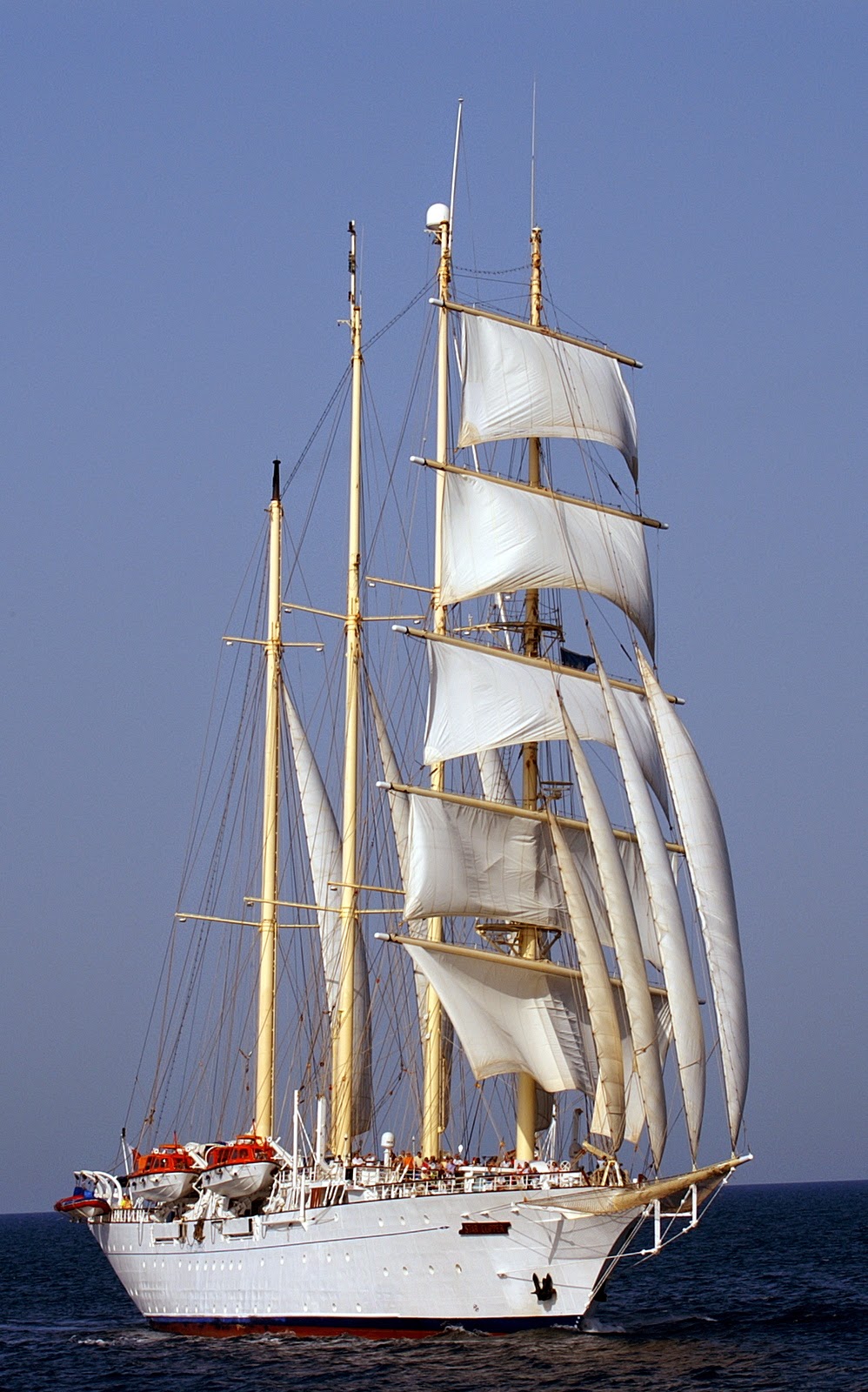
There is something about a windjammer that makes a cruising holiday so much more enjoyable than a voyage on a liner.  Perhaps part of the magic is the small size.  Although the largest full rigged sailing ship in the world, at 5000 tons Royal Clipper is well under a fifth the size of even the small liner on which I have previously cruised.  She carries 220 passengers and her dining room can accommodate every one of her passengers at once.  Since I had already decided that huge liners with thousands of passengers were a very long way from my idea of a good time, the individual attention afforded by Royal Clipper's crew to passenger ratio of almost 1:2 was extremely pleasant.

It so happened that during this cruise we berthed in one port alongside a giant multi-storey vessel that could only be described as a floating block of flats.  Pop music was blaring out of its loudspeakers and innumerable passengers returning from shore excursions were all trying to board at once before sailing time.  Thank you, but no, not for me.  Looking over from the deck of our little ship, we few Royal Clipper people felt very smug indeed.

Another thing that I found very refreshing was to be treated as an adult.  I sometimes despair of being regimented by holiday couriers as though I were a child of five.  On Royal Clipper they seem to say, "You know what?  This is a sailing ship.  There are ropes everywhere.  Since you are not a child we don't have to tell you not to walk into the ropes.  You can duck them or climb over.  Unless someone is actually pulling on a particular rope at the time you can, using care and your own judgement, pass by it.  Obviously don't get in the way of sailors handling the sails in difficult conditions. Otherwise go where you like." Oh bliss.

I might like to talk about the interior being a cross between an Edwardian restaurant and a private yacht gleaming with polished wooden paneling.  I might like to talk about the unbelievable quality of the food, cabins and service generally; perhaps the unfailing cheerfulness of a crew determined to ensure that everyone has the holiday of a lifetime without unnecessary distractions.

But of course it is the magic of sail that touches the romance in the souls of people like us who spend all of their normal lives in close proximity to electronics and machinery.  It is not that  Royal Clipper relies on her sails. She will normally use staysails  to augment the motor except against a headwind and her square sails too if the wind is abaft the beam, but she rarely needs to tack as she would without an engine and she does not tend to lose time to the weather, though on this cruise we did lose one port of call to rough seas. Nevertheless there is no question but that she is a proper sailing ship and not an ocean liner that just happens to have the odd sail.  In fact she has 42 sails, 5000 square feet in all, and on this voyage she set 41 of them at once.

Two aspects of sailing stick in my memory.  One is being allowed to fulfill a lifetime's ambition and actually climb up the rigging to the crow's nest.  Oh yes I did, and I have photographs to prove it!  The other was a match race between Royal Clipper and her sister Star Clipper off the Croatian coastline.  Whilst I may entertain a few doubts as to whether the race was slightly choreographed and whilst the deck never really leaned over far enough for this enthusiast's taste, it certainly provided the ultimate photo opportunity for a lover of tall ships.

Star Clipper (left) is technically a barquentine rather than a true clipper.  That means she only has square sails on her foremast.  You do not however notice this holding her back in relatively light winds such as we experienced, whilst our heavier vessel perhaps needed a stiffer blow.  Nevertheless I want to thank the captains and crews of both ships for providing so wonderful a spectacle.  (And if anyone who was on Star Clipper wants to swap photos, please do get in touch!)

Wednesday, 25 June 2014

The Highland Show

Not having attended The Highland Show for many years, I was greatly surprised at the wide variety of interest now offered by this celebration of country life. I could not list half of the crafts and skills on show, but some of the things that caught my attention were:


An informative lecture / demonstration on fly fishing that renewed my conviction that an expert in anything who possesses good communication skills is always worth listening to.  I could easily have been persuaded to become an angler.


The birds of prey were most impressive.  We are accustomed to see hawks and falcons, but here were eagles and vultures.  These are seriously  large birds and very beautiful in close up.


Seventeen heavy horse pairs drawing drays provided a picturesque spectacle in the main arena in the morning.  What a great thing it is that so many firms and individuals are willing to put the required effort into the preservation of a glorious piece of our heritage; one that still offers environmental and commercial benefits today.


I was also very taken with the private driving classes.  This is something that I really should like to try, though it is an area of horsemanship of which I know very little.  I hope I am not too old to learn something new!


Both the working hunter class and the Grand Prix showjumping offered spectacular opportunities for the aspiring photographer possessed of a decent long lens.  I quite surprised myself with the quality of image that my old Minolta 75-300 AF would produce at 1/500th of a second, even under slightly overcast skies through part of the afternoon.


And I have yet to mention the displays of farriery, sheep-shearing, willow weaving, dog agility, pole climbing and who knows what else.  I was impressed by the singing of the Farmers' and Farmers' Wives' Choirs, who seem to have reached a high standard in a very short period of existence.

Of course the show classes themselves are the heart of the whole thing.  I saw breeds of sheep that I had never even heard of and watched the parade of class winners for cattle and horses.

The whole event was well organised and informative commentaries were provided throughout.  I greatly enjoyed my day.

Monday, 23 June 2014

British Orchids

Once upon a time I thought that orchids were tender tropical plants with exotic flowers; the sort of thing that you could see in hothouses or in that beautiful collection in Jersey. Then a few years ago, much to my surprise, I found the permanent meadowland around my home in Sliabh Mannan full of strange plants.

I tentatively identified the more common of these (left), from a guide book, as the common spotted orchid (dactylorhiza fuchsii), though to my way of thinking that was a serious misnomer since I had never spotted it before.  It  turned out that the name signified the presence of dark spots on the leaves and spotted patterns on the mauve flowers.


Considerably less common was a much darker purple flower (right) that I thought was probably the early marsh orchid (dactylorhiza incarnata).  I claim no great conviction behind these identifications, so if you know better please feel free to let me know. There is a variety known as heath spotted and another called northern marsh that look superficially very similar.

The new flowers were attended by a locally new species of butterfly, the common blue, as reported in an earlier post (28 October 2013) of this blog.

For the next few years a few stunted specimens appeared erratically. This month however the meadows are once again full of these beautiful wild flowers. I suspect the mild winter has encouraged them, as it has so many tender plants.

Remarkably the magnolia in my garden flowered this year for the first time since I planted it, although I bought it years ago as a sapling already in flower.


Monday, 16 June 2014

Scotland and self-determination


If you confuse nationalism with patriotism, you are also likely to confuse self-determination with separation. Scotland was not conquered; a bankrupt country chose voluntary union because it desperately needed access to the financial resources of its more prosperous neighbour.

Those resources again rescued the country from bankruptcy as recently as 2008, when the UK raised £46 billion to save RBS.

That UK government was led by a Scottish Prime Minister and a Scottish Chancellor. Far from failing Scotland, it enlarged the national debt on Scotland's behalf. SNP leaders now threaten not to pay our share.

The sum needed to bail out a single Scottish bank contrasts with the half billion a year transaction costs the UK may suffer should it decline to share its currency.

It seems that, unlike the separatists, the UK government can do sums.

Saturday, 7 June 2014

Coblenz (Koblenz)

Coblenz is located at the confluence of the Rhine and the Moselle, to which its original Latin name refers. It is also the northern end of the Rhine Gorge and draws many tourists to visit the nearby castles and the legendary Lorelei Rock. Like many border cities it has been repeatedly fought over.

The most prominent fortification in Coblenz itself is Ehrenbreitstein on the east bank of the Rhine opposite the confluence on the west. The current fortress is 19th century and it is possible to visit it by cable car from the city. The immense flat interior of the fort also provides Coblenz with a grand venue for open air exhibitions.


The gathering place for tourists on the west bank is the narrow strip of land to the south of the confluence. This is known as Deutsches Eck (German Corner) and features an enormous equestrian statue of Kaiser Wilhelm der Grosse. The statue was destroyed in the Second World War and only certain recovered pieces are incorporated into the modern restored version.


The most prominent of the city's churches is the Basilica of St Castor, a Romanesque structure completed in 1208. In front of the basilica is a fountain dedicated to Napoleon's invasion of Russia in 1812 and two years later re-dedicated by the city's Russian occupiers.

The Electoral Palace is a baroque building, now a museum, featuring a view  across the Rhine.