Wednesday, 29 July 2015

Arles

One hundred and twenty five years ago today, Vincent Van Gogh died.

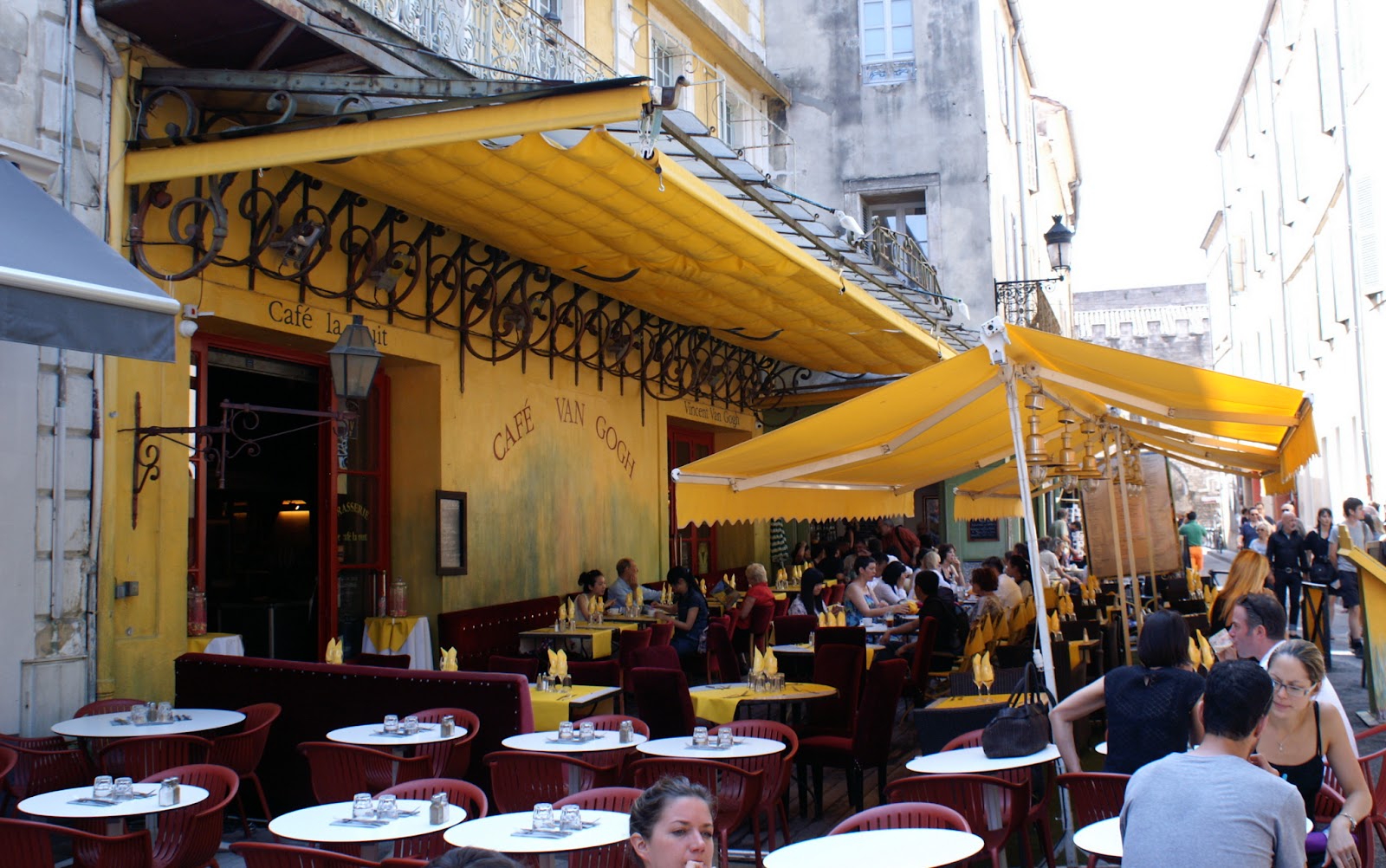
Of the three sites in Arles most associated with him one, The Yellow House, was destroyed during the Second World War but The Hospital (left) and The Night Cafe (below) can still be visited today. Appropriately the latter is still painted yellow. I was not able to photograph it at night, but my picture was taken from a not totally dissimilar angle to that of the painting.


The Van Gogh connection is not the only reason to visit Arles.  I was unprepared for the remarkable state of preservation of the Roman Amphitheatre, which is today still in use for bull fighting (with Spanish bulls) and the racing games featuring the smaller Camargue bulls.

Though much smaller than the Roman Colosseum, the Arles amphitheatre has suffered less depradation by builders looking for a cheap stione quarry.  This was because it served as a fortress on the bank of the Rhone (below)  and was able to contribute to the defences of the town.

Considerably less grand are the late Roman Empire baths, the contrast between the two clearly evocative of the decline of Roman civilsation, even if the latter was the work of Constantine.

Arles was frequently a Roman headquarters and briefly a usurper capital.  It is also known as an early site of the religious conflict between Rome's Catholicism and the Arianism of the Visigoths, the independence of the latter no doubt being strengthened by the local traditions originating from Les-Saintes-Maries-de-la-Mer not far to the south.

The Emperor Barbarossa was crowned here in the 12th century, but Arles' importance declined as that of Marseilles grew. Today, perhaps especially today, it is probably best known for its association with Van Gogh.

Saturday, 25 July 2015

Les-Saintes-Maries-de-la-Mer, Camargue

According to legend, a party of disciples fleeing persecution in Judah shortly after the crucifixion sailed to the south of what is now France and landed in the location of the present town of Les-Saintes-Maries-de-la-Mer. The refugees included the three Marys: Magdalen, Salome and the mother of James, along with Martha of Bethany and Joseph of Arimathea.

In the Camargue, no-one would entertain the notion that this story is not literally true. Though the whereabouts of the Magdalen's remains are disputed, everyone knows that Salome and the mother of James are buried in Les-Saintes-Maries-de-la-Mer (above right) and Martha in Tarascon (below left). It is unthinkable that the popular medieval competition between shrines to rediscover relics of saints in order to attract pilgrims, the medieval equivalent of tourists, had anything to do with it.

Even leaving aside the question of relics, the association of Mary Magdalen with the area has very strong traditional roots. It was of course a part of the old story on which The Da Vinci Code was built. The Albigensian Heresy (Catharism) in the early middle ages, and the 19th / 20th century mystery of Rennes-le-Château have also some possible links to the story.

Today these churches are still places of pilgrimage, and 
Les-Saintes-Maries-de-la-Mer is the site of an annual Roma pilgrimage in honour of their patron St Sarah, whose relationship to the ship of refugees is not entirely clear.  She may have been a servant or a local woman who welcomed them.

The strength of feeling that surrounds these places is entirely convincing to romantics like me.

Wednesday, 22 July 2015

Chilling Ghost Stories


Available worldwide, it is hoped, around the end of next month will be three books of a Gothic Fantasy series from Flame Tree Publishing. Books will also be on sale directly at flametreepublishing.com. Why should you especially want to bear this in mind?  Because the first in the series, Chilling Ghost Stories, features a tale written by me.

As you might expect, I do not tend to write traditional ghost stories and 'The Waiting Room' is definitely not traditional. It is however in some high class company in the forthcoming volume, so I hope you will all rush down to your local bookseller and reserve yourselves a copy.

Better still buy several copies and give them to all your friends for Christmas.  Have your Christmas shopping finished by September.  Now don't say you never find any good advice on this blog!

Monday, 20 July 2015

Pont de Gau, Camargue

I could happily spend all day in a bird reserve. Since I know myself only too well I took careful measures to be back on time on this occasion, though I needn't have worried because another keen bird photographer was late back to the bus instead of me.

The salt marshes of The Camargue are full of exotic species; wild birds being encouraged to congregate inside the bounds of Pont de Gau by feeding. The Greater Flamingos cluster in garrulous flocks close to the shore of  small lakes, demonstrating by their high stepping strutting that the water is only inches deep and especially convenient for their strange but logical method of sieving the oozy mud below through odd-shaped beaks.

Other species are slightly less gregarious. Greater Egrets seem to have slightly more respect for each other's personal space and roost several feet apart. Yellow-crested Cattle Egrets seem to mix in with their all-white relatives without concern, and even the often solitary grey herons will join the family groups.

It is quite hard to take a bad photograph where large birds are so concentrated. After some time photographing birds on the ground, I decided that take-off and landing presented greater challenges, though my attempts here also caused me to waste many more exposures. It is so easy to have the wrong depth of field and end up with part of a bird out of focus. If it happens to be the head that you have wrong this will ruin the shot, yet the recommended technique of focussing on the bird's eye is remarkably difficult if the bird is moving.

You need good reflexes and a steady hand; I was usually quite pleased just to get the whole bird in the frame. The White Stork on the left obligingly assisted by coming in to touch down in just the right spot.

There are lots of tracks around the lakes of Pont de Gau and it is easy to find yourself on your own, even when there are crowds around the cafe and enclosures. 

For any naturalist in The Camargue, a visit to Pont de Gau should certainly be on the agenda.  Take several lenses, spare batteries and lots of time.  Oh, and if it's a still day, take mosquito repellent!


Sunday, 19 July 2015

White Horses of The Camargue

Many of us dream of visiting the Rhone delta, the sparsely populated area of southern France known as The Camargue. Like many other dreamers,  I imagined I was going to take lots of photographs of lovely white horses running out of the surf.

Truth to tell, that sort of picture has to be staged for the photographers by the traditional cowboys of The Camargue. The horses do not actually spend their time playing on the beach. Why would they?

So unless you're very lucky, you have to make do with a misty photograph of grazing horses taken through the window of a tour bus. A bit like the one on the left.

The most important town of the region, Les Saintes Maries de la Mer, of which I hope to write more later, has an off season population of below 3,000 but a summer population of 50,000.  There see to be innumerable  trekking establishments where you can ride the white horses amongst the salt marshes, winding your way between the many lakes and observing the fascinating wildlife.

To a person from northern latitudes, egrets and flamingos count as exotic, so it is astonishing to see the wild birds that flock to the reserve at Pont de Gau. I hope to write at greater length about that wonderful place too.

For now, however, I have still my dreams about what Camargue might have been like, if only I had been on my own and not surrounded by a crowd of other tourists such as myself!

Thursday, 16 July 2015

The Euro makes you sick

If anyone still believed in the community spirit of the European Union they should have found themselves roundly disabused this week.

I have discussed in earlier blog posts the fundamental flaws of the Eurozone system. In brief, by removing the economic safety valves of devaluation and balance of payments effects, a single currency drives countries of unequal efficiency further and further apart by reducing the GDP and employment levels of the weaker.

In single currency areas such as the USA and the UK relatively little fuss is made about arranging compensating financial flows because the members are all parts of a single political state. The Barnett Formula exists to provide this compensation to Scotland (despite imaginative claims for the alleged strength of the Scottish economy.)

In the Eurozone there is no such political unity. This week has seen economic liberalisation measures forced on Greece as the price of its third bailout in six years that are too extreme even for the strong economies such as Germany to stomach themselves.

Yet as the leaked IMF paper reveals, the measures proposed will not allow Greece to pay off its mountainous debts. For all its ineptitude, the Syriza government has been correct about one thing; the so-called remedies are making the situation worse by increasing Greece's debt to GDP ratio.

The common cliche describes the Eurozone as kicking the can further down the road. I prefer to describe them as treating the symptoms (badly) whilst denying even the existence of the disease. Something is rotten at the heart of the single currency and no amount of name calling and blame allocating will put it right.

Wednesday, 24 June 2015

Full Fiscal Autonomy?

During the Scottish Referendum campaign, the question of a sterling currency union was controversial. There were claims that the pound was as much Scottish as English, which were true but which cunningly sidestepped the fact that the pound is not English either. It is the currency of The United Kingdom.

In previous posts on this blog I have discussed the difficulties that are bound to beset two economies of disparate size and structure that attempt to share a common currency. I concluded that the Chancellor was right to rule out a currency union between the UK and an independent Scotland.

Current discussion about Full Fiscal Autonomy for Scotland has so far failed to recognise the same currency problem dressed up in different words. What will happen when a single UK monetary policy is undermined by a fiscally autonomous Scotland adopting a borrow-and-spend stance whilst UK policy is still following a strategy of deficit reduction?

The answer is to be seen in the continuing Eurozone crisis. Under the monetary aegis of Germany, Greece, with Full Fiscal Autonomy because nobody respected the European Stability and Growth Pact, borrowed excessively because borrowing was far too cheap relative to the performance of the Greek economy.

In consequence for Greece the financial crisis of 2008 speedily became a debt crisis. This week's efforts are but the latest attempt by the Eurozone leaders to kick the can down the road one more time, still without addressing the fundamental absurdity of linking Germany and Greece within the straitjacket of a common currency.

It should not have escaped anyone's attention that the Greeks blame the Germans for not lending them more, whilst the Germans are tired of what they see as Greek profligacy. Is it really very difficult to look a little way into the future and see insults being traded between the Scottish and UK governments in remarkably similar circumstances?

The oil revenues that were to be the foundation of Scottish solvency now look like pie in the sky and no-one has much idea how to plug the huge pending revenue shortfall. Vague appeals to the extra revenue that economic growth might yield in the longer term, even if they turn out to be more than just wishful thinking, cannot hide the fact that in the short term Scotland must either tax or borrow heavily, or more likely both.

Full Fiscal Autonomy is incompatible with a common currency. Before our half-baked, less than half thought-through devolution process goes anywhere near it we need a clear, written federal settlement and firm fiscal constraints upon the budgets of all UK member states.

Monday, 15 June 2015

The Culloch Burn

The Culloch Burn is a stream which flows into the River Avon in Slamannan, a village in the middle of Sliabh Mannan.  The Stirlingshire Avon is unconnected, except by name, with the considerably more famous river running through Shakespeare's Stratford.  In fact the name Avon derives directly from the Celtic word for river and there are several examples of the unimaginatively named 'River River' throughout the United Kingdom.

Although the village is more than 400 feet above sea level it lies in a natural basin in Sliabh Mannan, meaning the only ways out are all uphill. In consequence the lowest parts lie within a natural floodplain and any drainage bottleneck is vulnerable to being overwhelmed after heavy rain.

People who do not live near the headwaters of upland streams find it hard to take warnings against flooding seriously, as I have had occasion to remind local Council planners before now.


The above photograph shows the Culloch in a dry season. That's right, you can't see it. You can however see its banks just behind the electricity pole. You might even wonder how such a little burn has cut so deep a channel and why constant erosion is regularly changing its winding course.

An official will come out on a sunny summer day, observe this trickle of water and condemn as fantasists your correspondent and others who advise them to be careful when zoning areas for housing development.  Such a feeble watercourse, he thinks, could not flood a child's paddling pool.


Well the next photograph shows what can happen if it rains for a couple of days. You can still see the long rushes that mark the course of the Culloch, but now the burn is about a hundred yards wide because it has burst its banks and inundated the flood plain. 


Turn left from where the first two pictures were taken and you can just make out the outskirts of Slamannan, towards which the Culloch is flowing.  It is there where it joins the Avon as, in normal circumstances, a tiny tributary of a small river.


But when the Culloch looks like this, the confluence obviously poses more of a problem.

Now imagine what is likely to happen if additional housing were to be constructed on the southern outskirts of Slamannan, increasing the flow of surface water by reducing natural absorbency and also increasing domestic drainage into a system as volatile as this.

You're right.  Not smart.  So if in spite of my advice such developments go ahead, please remember:

I TOLD YOU SO!


Wednesday, 3 June 2015

Passage of Time

When I first began writing short stories, I made several entries in the Aeon Award Contest run by Ireland's Albedo One Magazine. One of these stories made the quarterly shortlist and I promptly jumped to the erroneous conclusion that I had cracked this short story writing business.

In fact of course I still had an awful lot to learn; there is a considerable gulf between the literary demands of novel writing and those of short stories.  It took a year between my first published piece of flash fiction Elementary Mechanics and my first published short story, Spatchcock. There followed another ten months before The Old Man on The Green.

Of the four acceptances that I received earlier this year, two have so far been published and two are still awaiting publication. The queue awaiting a public airing have now, I am pleased to say, been joined by another story, Passage of Time which will finally take me back very close to where I started when it is published in Albedo 2.

This is my first acceptance outside North America, so with luck I am getting closer to being published at home, though of course the market in the UK is small and opportunities far fewer.

Passage of Time will be my first published story set (at least partly) aboard a space ship. I wouldn't really call it a space opera, since most of the conflict portrayed in the tale takes place upon Earth. However it does feel as though I'm getting closer to my ideal of being an all-round speculative writer.

By the way, I do write non-speculative stories too. So far none have made it to publication, but a couple have been competitively placed and I hope may yet see the light of printed day.

Saturday, 30 May 2015

Sum You Lose

The recent electoral success of the SNP throws the spotlight back on the question of Scottish independence. It seems few people remember that the economic forecasts of the nationalists were discredited within months of last year's referendum. Perhaps therefore a summary of the crucial points might be appropriate.

In December 2013 The SNP published Scotland's Future, a document long on words and short on numbers. Yet amongst the numbers it did contain, one received surprisingly little attention. It was projected that in the first year of independence the Scottish fiscal deficit would be £4.4 billion, or approximately £1,000 for every adult member of the population.

Remember that figure, it is important. At a time when people were blithely talking about being one of the richest countries in the world, creating a more caring society and setting up an oil fund for the benefit of future generations, the numbers actually showed that Scotland was already living beyond its means and proposed to go even further into debt.

In order to arrive at this deficit figure, they made assumptions about likely sources of government revenue. Large receipts were expected from taxes on Scotland's oil and finance industries, which together form a disproportionately large component of our national income. Assumptions were also made that Scotland would continue to use the pound sterling as its currency and that Scotland would run a Balance of Payments surplus. All four of these assumptions were flawed.

Official statistics were pessimistic about future oil prices, given the threatened slowdown of the Chinese economy and the rapidly expanding supply of cheap shale gas from the USA. Alleging deliberate manipulation of the figures to disparage the potential riches of an independent Scotland, the nationalists substituted their own oil price estimate (of over $110 per barrel). In fact the official statistics turned out to have been over-optimistic. In 2015 oil prices are in the range $50 to $60, around half the nationalist projection. So far from supporting an independent Scotland, the oil industry was soon in need of UK government help.

The UK Chancellor of the Exchequer challenged the assumption that Scotland would continue to use the pound sterling. He expressed himself poorly. What he meant to rule out was a currency union by which the rest of the UK would continue to underwrite Scottish finances. Fresh from the 2008 banking crisis in which UK taxpayers had been required to find £46 billion to bail out Royal Bank of Scotland, that was hardly surprising.

His lack of clarity was misrepresented as a threat. "No-one can stop us using the pound," Alex Salmond declared. This was of course true. Surprisingly he did not go on to explain that no-one could stop us using the dollar or the yen or the Zambian Kwacha either.

An independent country may use any foreign currency it likes, provided it can get hold of enough by means of a trade surplus. Panama, for example, uses the US dollar. All that you have to do is give up any desire to control your own monetary policy. If Scotland were to use the pound without a currency union it would have no choice but to accept UK monetary policy as its own.

It also means the Scottish government could only run a fiscal deficit to the extent that it could cover the revenue shortfall with reserves of sterling.

An odd sort of independence, you might think, that resulted in less economic powers than Scotland already has?

When the currency problem became clear, the large Scottish financial institutions announced plans to move their services to UK customers south of the border. This was not simply a brass plate technicality to comply with EU regulations as nationalists claimed.

Banking profits derive from the difference between the interest rates at which banks can borrow and those at which they can lend. Essentially a bank's lending operations create new money and most of the money supply in a modern economy consists of bank deposits, not cash. In order to perform these money-creating operations, banks must be within the jurisdiction of, and accept regulation by, the central bank responsible for that currency. A bank attempting to create new foreign currency would be acting illegally; it can only operate in a foreign currency to the extent that it possesses reserves of that currency.

The net result of this alleged technicality would therefore be twofold.

      1. Scotland's financial institutions would be responsible to the Bank of England and pay their taxes to the UK Treasury.

      2. Without financial exports it is unlikely that Scotland could run a Balance of Payments surplus. This would eliminate the Scottish government's ability to acquire reserves of sterling and thereby to run a fiscal deficit.

Now please remember the important figure that I quoted at the beginning of this article. By the SNP's own projections, the fiscal deficit in the first year of independence was to be £4.4 billion.

This was before accounting for the fall in the oil price and the loss of the financial services industry. It was before losing control of monetary and overall fiscal powers as a result of sterling becoming a foreign currency. This £4.4 billion deficit was actually a serious underestimate, perhaps not within several orders of magnitude of the reality.

Not only would a future Scottish government be unable to afford the promised fairer society, it would have to borrow improbable sums just to keep public spending at present levels.

Why improbable? Because in order to borrow you must first establish that you are creditworthy. Why might the international financial community suspect that Scotland was not creditworthy? Because the SNP threatened that if they did not get their own way on the currency they would walk away from responsibility for Scotland's share of the UK National Debt.

Let us leave aside whether one could throw over this debt without sacrificing Scotland's claim to a share of the national assets and infrastructure which that debt has financed, much of which is not located in Scotland and nearly all of which would need to be replaced by an independent country starting from scratch.

Let us also leave aside the fact that a country involved in a major financial dispute with an existing EU member would struggle to find an easy path to re-joining the EU.

Just consider this single point. What international lenders would offer reasonably priced funds to a new government whose first independent monetary act had been to deny any responsibility for debts accumulated jointly under the previous political union?

I am an economist. But of course I am also human. I might be wrong. To persuade me that I am, would enthusiasts for independence please not shout at me. Just show me your numbers.

And before you do, please check that they add up.

Tuesday, 26 May 2015

Falkirk Festival Writers Seminar 2015

This was my sixth attendance at the annual seminar run by Falkirk Writers Circle for authors from all over southern and central Scotland.  Each year usually sees competitions for short story, article and poem with a special additional category.  This time it was flash fiction.

One thing that writers must overcome is fear of speaking in public. If you do achieve success in being published, you are likely to be required to promote your own work. The chances are you will have to do book signings or readings in various locations and give talks to all sorts of audiences.

Of course being a good writer doesn't make you a good speaker, so it is very helpful to those who are inexperienced in the latter skill to have practice in reading to an audience of other writers who are going to understand.

To an audience it can be remarkably difficult to follow a story read out by an author who has not yet mastered the art of reading aloud, so it is also helpful that the judges are given time to explain their rankings and what they are looking for in the various competitions.

For some reason I specialise in submitting entries that would have suited last year's judges. All too often I find myself on a track with which this year's judges do not sympathise. I have however a fairly good idea of what I do well, so I have decided to do that every year regardless of who happens to be judging.

Last year that produced a surprising first place in the short story competition with a very experimental story.  This year my best result was a perhaps even more astonishing second place in the flash fiction competition judged by Silvie Taylor. I must confess I had thought the classical puns in this little story were far too outrageous for such a competition, so I was very pleased with the result.

Tuesday, 19 May 2015

Being your own editor

I read nineteenth century novels for fun. Well, either that or I'm a cheapskate and you can read nineteenth century novels for free. The problem is that when I've read one I have a dreadful habit of writing like its author when I return to my day job of story writing.

I was given a bit of a jolt recently by a slush reader's feedback - the sort of thing you get from some magazines when your story's not good enough for a personal rejection and not bad enough for the unsubtle hint that they'd just as soon you didn't send them any more. This reader criticised my slow pace. Then as an afterthought he wondered whether I was trying to write as though I were a nineteenth century novelist. That, he thought, might be clever but was never going to sell.

Now this particular story had started life at something approaching 11,000 words. Then with difficulty I edited it to 9,800 so as to meet another contest's 10,000 word limit. I had, as usual, very high expectations. I got straight rejections. I tried again until I got the above comment.

As it happened, I had received an encouraging personal rejection for another story of a similar genre at about this time, but from a market whose word limit was about half the length of the original version of this story. I had a bit of a think. What were the chances of cutting out so much? Well I had often read that it was good practice to try and reduce your story by a third, so I reckoned it must be even better practice to try and almost halve it. I set to work.


I stress that I really liked the original version of this story myself. Of course I'm the guy that likes nineteenth century novels too. As I got going I discovered lengthy lyrical writing about the setting of the story; so lengthy in fact that the story was sometimes put on hold for a page at a time whilst my Point-of-View character took a look around in all directions. And then moved a few yards and got a different view and did the same again.

Now writers are always warned against white room writing. This means not engaging your reader in the setting at all and ignoring all or most of the human senses in your enthusiasm for the story and nothing but the story. Whilst the writer can see the setting in his own mind, the reader cannot unless the writer paints the scenery and populates the landscape for him.

But perhaps at the other extreme we should also be warned against what I might call Art Gallery writing - if we might consider a gallery to be the opposite of an empty room. A lot of the pictures in an average gallery don't attract the average visitor's attention. Fortunately. If they did, I'm told, it would take ten years to walk around The Hermitage in St Petersburg (left).

Anyway, in very short order I had removed 1,000 words from the first eight pages of this story. The thing was I was really enjoying this process. I found myself developing an instinct for the difference between description that was vital to the story and description that was there for its own sake.

So I ended up with a story halved in length and zipping along, if not like a racing car at least like a  buggy drawn by a spirited horse. And I couldn't believe how much better I liked it. I read it again and again without even threatening to get tired of it the way I can easily do with some (though not of course all) of my longer stories.

Since then I think I may be more sparing with unnecessary description, but I still think it's a worthwhile exercise to be your own editor for a while.

Saturday, 9 May 2015

Scotland's Voice

In order that 'Scotland's voice shall be heard' we Scots have decided to change our traditionally successful tactic.

Hitherto we have sent to London representatives of UK-wide political parties who could and did take a disproportionate share of the great offices of state.  Two recent Prime Ministers, three chancellors, foreign, home and defence secretaries,  the outgoing Chief Secretary to the Treasury and numerous other ministers have been Scots.

For some reason the English, Welsh and Northern Irish used to be content to allow Scots to run the country. But that wasn't enough for us, so we have now sent to London 56 members of a purely Scottish party who, with no significant allies at Westminster, cannot hope to hold any UK office of state at all. Scotland's voice will no longer be heard in the cabinet room or in senior departments as it has been up to now.

Perhaps someone will explain to me how having our representatives shouting from outside the cabinet room is more likely to ensure that Scotland's voice is heard than having several of the most crucial seats inside was.

Confined to opposition, it will be tempting for Scotland's representatives to become shrill and peevish. We have no-one but ourselves to blame for this loss of influence. Since austerity is the current UK government's policy and the SNP demands an end to it, we can hardly be surprised if we are told we have leave to spend more money in Scotland provided it is all raised in Scottish taxes.

Friday, 1 May 2015

Miaow do you do?


Now come along, you can’t expect me to believe that you didn’t know cats could talk. I mean, everyone knows that cats are much more intelligent than people, don’t they, and people can talk.

Well, yes, now you come to mention it the conversation of some people is a trifle limited. My Aunt Tabitha; she was the one who stayed in Cowcaddens, you know; she once told me that the local people there only ever learned one adjective, but that they were so pleased to have learned it that they used it over and over again, every fourth or fifth word, so that it became meaningless; you know, the way that a cat might say “you know” or a rather dull human might say “er…” Apparently this adjective began with f, but it wasn’t a clever word such as “F-eline” or “F-rolicsome”; not even a moderately clever word such as “F-ornicating”, though apparently it was a synonym for that. My Aunt Tabitha, you know, was always too F-astidious to mention what the word actually was; she called it “the F-word.” Personally I know rather a lot of adjectives beginning with f, but then of course, I am a cat.

I suppose what you really mean to say, in your limited human way, is that you are surprised that a cat would condescend to talk to you. It is true that the majority of cats can’t bring themselves to do such a thing. They go through their entire lives without uttering a word in human hearing. They have very delicate empathy with human sensitivities, you know, and they are only too well aware that people feel themselves sufficiently inferior to cats already, without being subjected to the further indignity of having their ignorance exposed in conversation. My Aunt Tabitha used to say that, even for an intelligent human, talking to a cat would be rather like a Rangers supporter talking to Einstein. No! Einstein was not that foreign coach who was hired by Celtic; he was that foreign coach who was hired by Princeton. No, Princeton don’t play in the English League, they play in the Ivy League.

I had better get to the point. Well then, I suppose that you could say that the whole problem started when my people, (you know, those are the humans that I keep as pets; they do useful things like opening cans and lighting fires for me in the winter?) well, they brought home a dog. Now I can cope with dogs; they aren’t very smart, even less smart than humans, but as a general rule they understand simple instructions that come reinforced with a swift right hook to the nose, claws extended – know what I mean? Well that’s all very well for elementary house rules such as who gets to eat first, or who gets to lie closer to the stove, but legally binding job demarcation lines are really too complicated for a dog. I have to say that I did my best to explain the principles of mouse-hunting, but I could see by the glazed expression on his face that the mutt really wasn’t taking it in.

“The whole point,” I said slowly, “is not to kill the mouse. If you kill the mouse, then it stops running, you see, and it’s far less fun hunting it if you have to throw it up in the air first and then run after it.”

“But I run after a ball when my person throws it, and that’s fun,” said the stupid dog.

“You don’t understand,” I replied patiently, “If you throw the mouse it can only travel in straight lines. When it’s running it can jink about and turn corners and stuff, and that makes the hunt much more interesting.”

Well the clown said that he would try to remember, didn’t he? But what happened? The next night there’s a mouse in the kitchen, and I cunningly head it off from running back to its hole, don’t I? And so the mouse hides behind a wide-open door, you know, one that’s opened right back on itself so that there’s just this narrowing V-shape for the mouse to run into? So I’m just about to adopt the classic position, where the mouse is stuck up the narrow end and I’m blocking the wide end, staring at it and frightening it to death with my penetrating gaze, when this stupid dog jumps in and grabs the mouse! I ask you; just grabs the mouse without so much as a by-your-leave!

You can tell that this dog doesn’t know there’s a recession can’t you? I mean there are livelihoods at stake here. In my capacity as local shop steward of the Feline Artisan Rodent Manipulators and Carnivorous Allied Trades Society (FARMCATS for short,) I lodged a formal protest right away, I don’t mind telling you. “All my members want at the end of the day” I said firmly “Is a fair day’s stalk for a fair day’s slay.” But it didn’t do any good, you know, because the mouse was already dead, wasn’t it?

Well, as you can imagine, I was feeling properly humiliated by this, because my absurd people told the dog how clever he was for catching a mouse. For goodness’ sake, as though there was any skill in catching a mouse! All the skill lies in prolonging the hunt; even a human should know that. Oh, you didn’t know that either, eh? Well I can’t say that I’m surprised.

In any case, to cut a long story short, I decided to go and sulk in the stables, didn’t I? “Let them see if the miserable mastiff can fluke more than one mouse,” I said. “You’ll see, they’ll be over-run with rodents and pleading for my return in no time.” But, in fact, no sooner had I stepped outside the back door when there’s this dreadful twittering noise and this crazy swallow dives on me from twenty feet in the air. He zooms past about three inches from my head and climbs up into the air again chattering some rubbish about the stables having been occupied by hirundine popular forces and being out of bounds to cats for the duration of the nesting season.

Now if you think it’s tough explaining something to a dog, you should have a go at trying to get through to a bird-brain. This guy had a completely one track mind; every time I would leave the house, the same thing would happen; twittering, dive bombing and a political lecture about the avian master race. I couldn’t go and sun myself on the lawn; I couldn’t move from one shrubbery to another in a leisurely field-mouse hunt without this numbskull diving on me out of the clouds. I think he’d been watching a lot of those old war movies, you know, where the German Stukas roll over and dive bomb the refugees with a great wailing of those huge sirens that they had fitted in their air intakes. You’ve seen them, haven’t you? Eeeee–yowwwwwwww–boom! And then zoom back up into the sky. Oh good, that’s something you do know about! Maybe you’re not quite as green as you’re cabbage looking?

So now I not only had this stupid dog parading about the house and crowing about how he’d beaten the cat in a mouse hunt, I also had this stupid bird parading about outside the house and bragging how his Stuka act was protecting all the little swallows. I ask you, as though I would have eaten any of his stupid hatchlings – well, not more than my fair share anyway. I mean, you must be able to see that the situation was intolerable? What I needed was a master stroke that the dog could never pull off and that would teach that bird a lesson. As my great-great–ever-so-many-greats grandfather famously said to Cleopatra, “You want to be careful with that snake, lady, you could fall right on your asp!” So I went off and did some research on the Intercat, didn’t I? Simple really.

Anyway, as I told a completely crestfallen dog afterwards, a wise cat once observed that there are old swallows and there are bold swallows, but there are very few old, bold swallows. I bet you didn't know that the Ju87 Stuka had to be fitted with automatic dive brakes that pulled up the nose at the end of a bombing run? This was because the G forces at that point were so great that the pilots could black out. For a critical couple of seconds the aircraft was actually flying itself and therefore its behaviour was very predictable for ack-ack gunners. Not a lot of people know that.

Considering what happened when I put my research into practice, we are bound to conclude that not a lot of swallows know that either.

Friday, 24 April 2015

The Swallows Are Back


The annual migration to Sliabh Mannan of the house martins (bottom right) and swallows (top left) began a week ago.

It always seems to me a wonderful thing that these small birds can make the journey of many thousands of miles from southern Africa, yet even more astonishing is that each year they travel such a great distance in order to resume their interrupted residence in my outbuildings.

What, I wonder, is the nature of the advertising used by hirundine travel agents in the spring? Come to beautiful Sliabh Mannan folks; 500 feet above sea level, unspoiled natural surroundings and all the midges you can eat? Time share in a 1783 stable block with your old friends the horses? Play amusing games in the garden diving at the cat? Sliabh Mannan is THE place for a bird to be at this time of year.

Well, whatever the persuasion they employ, it seems to work. Here they all are again, remodelling and refurbishing last year's nests, zooming all around the farmyard and twittering loudly at each other, no doubt exchanging news of how they outwitted the bird hunters in Cyprus or drought in the Sahara.

Welcome back boys and girls. Now I know it's really spring!

Thursday, 16 April 2015

Writing and its Rewards

I do not write in order to win awards. I don't actually know anyone who does, though I would not suppose it impossible for someone to so so. That does not mean of course that I should not like to win awards. I am no more immune to the natural human desire for recognition than anyone else.

Though any artist would like to produce art for its own sake, unless you are very self confident it is hard to go on producing work that you can't sell. You do begin to wonder; if you are the only person who can see merit in your work, then does it really possess the merit you suppose?

Writers even cherish that strange publishing phenomenon known as a personal rejection. Magazine editors and other publishers receive huge volumes of unsolicited submissions that they call 'slush'. Much of this they may not even read themselves; they delegate to 'slush readers' who are often other writers trying to gain experience. All of us wonder from time to time how many gems are missed in this sifting process.

If a slush reader refers a promising story up the line to a second reader or editor, the odds are still against it appearing in the magazine, but sometimes, if the editor sees promise in your work, he will write back and tell you why he's rejecting it. This gives you pointers as to what you should be looking to improve on in future submissions.

This 'personal' (as opposed to 'form') rejection offers the writer encouragement to continue. At least one editor thought your work was not total rubbish.

One stage better is the 'rewrite request'. This is when the editor tells you the story is good but has, in his or her view, faults which would have to be corrected for the story to be published. You are invited to try again with the same story if you wish. As a general rule, writers struggling for publication credits certainly do wish, though you could always stand on your dignity and insist that your work cannot be improved upon. I have already stated as a matter of public record that my story 'The Man on The Church Street Omnibus' was much better after the suggestions that I received from Alison Wilgus of The Sockdolager than it was as originally submitted to her.

Those of us who have stories published on line may also receive feedback from reader comments in the publication itself or in some other forum such as this blog. Every little helps, and positive criticism in the sense of suggesting how things could have been better is welcome. Not all of us are robust enough to take negative criticism, the usual answer to which is, of course, that if you don't like it you are not forced to read it.

If awards serve any useful purpose it is to praise artistic merit. There would be no point in an award that simply recognised the highest sales, since such authors already have their reward.

Sometimes awards are judged by a panel. Panellists have to be pretty robust because some of the time they are going to face hassle from those who cannot understand, appreciate or agree with their choices.

Some awards, like the Hugos, the prestigious awards in the science fiction genre, are voted for by the members of the institution which instigated them. In this case there is an intermediate 'nomination' stage to whittle down the qualifying writing to manageable numbers for voting.

The controversy over that process this year has been loud enough to reach the ears of dwellers in the wilderness such as myself. Whatever the rights and wrongs one can only be sorry for the outcome.

This is just not the reason we write.

Saturday, 11 April 2015

A Poem - No Escape

A comment on an earlier blog post asked whether I wrote poetry. I do indeed, though it seldom gets an airing and is even more rarely submitted to publishers.

I do quite like to write poems in Yorkshire dialect (known as Tyke). Back in 2010 when I belonged to the Falkirk Writers' Circle I was impressed by the ability of some members to write poems in Scots. Now my original dialect was not Scots but Tyke. For one meeting we were asked to write a poem on the subject 'No Escape'. This was the poem I wrote for that meeting.  Sorry - no photographs of an Ark handy!


No Escape


Owd Noah ‘ad a magic cloak wi’ ‘ygroscopic properties,
That is ter say ‘e wore it when ‘e wanted it to rain.
E got it from the weather clerk, the archangel ‘ose job it is
Ter turn them ‘eavenly sprinklers on, and ter turn ‘em off again.

Nar listen ‘ere, owd Noah,” says the archangel ‘oo give it ‘im,
This ‘ere’s a mighty BIG job that The Lord ‘as given thee.
No matter what’s on TV, or if the football’s rivettin’
Jus’ thee mind an’ tek thy cape off, lad, afore thee ‘as thy tea!”

Nar Noah was a good soul, though some would say a wally. ‘Ey,
For years and years ‘e did the job and never would complain,
E organised the sunny spells so folks could go on ‘oliday,
And then ‘e put ‘is cape back on, an’ ‘e give the farmers rain.

When Noah turned six ‘undred, ‘e were old an’ a bit silly, like,
An’ ‘e got a bit forgetful, as very well ‘e might,
E went up Blackpool Tower wi’ ‘is cape on, ‘cos ‘t were chilly, like,
An’ e sat down in a deck chair, an ‘e fell asleep all night.

When Noah woke next morning, ‘e saw all the world were water,
An’ t’ top of Blackpool Tower were the only bit left dry.
The angel said “’Ee Noah lad, there’s been an awful slaughter,
An’, there’s thee wi’ thy cape on still as t’ floods are risin’ ’igh.”

Oh dearie me!” says Noah, an’ ‘e jumped up from ‘is deck chair,
E took is cape off straight away; ‘e’d ‘ad an awful fright,
What shall we do? All Lankyshire is waterlogged and wrecked; there
Is not a chance Old Trafford’s pitch’ll be playable tonight!”

I’ll tell thee what,” says t’ angel, “’Ere’s what’ll see us through lad,
We’ll cut off top o’t’ tower, like, and mek a kind o’ boat
An’ tha’ can bring all t’ animals that live in t’ Tower Zoo, lad
An’ we can call it Noah’s Ark an’ eastward we shall float.”

An’ when we’ve crossed o’er t’ Pennines ‘igh, then we shall find an ‘ome, lad,
In t’ West Riding o’ Yorkshire; we’ll in God’s county dwell,
Meanwhile I’ll shove this water ‘ere, right out in t’ ‘lantic foam, lad,
An’ if ’n t’ sea gets deeper, well, be years ‘fore they can tell.”

So all thee long-‘aired scientists, wi’ thy dire prognostications,
Wi’ all thy glaciers meltin’ fast and and all thy stats on tape,
It’s nowt ter do wi’ isobars, or green’ouse emanations,
An’ it’s nowt ter do wi’ climate change; it’s ‘cos of Noah’s Cape!


Thursday, 2 April 2015

Wizard of Oz Election?

A column in The Times this week suggested the forthcoming election was like a contest between the Wizard of Oz characters Tin Man and Scarecrow; a party with no heart versus one with no head.  It went on to suggest the SNP was exploiting these mainstream shortcomings.

In my judgement, the SNP takes to even more egregious lengths than the mainstream parties the art of promising the manifestly undeliverable before wrapping the whole package in the mawkishness of a pledge to  deliver the victims of non-existent oppression from their imaginary chains. If ever there was a political grouping careless of its own shortcomings it is the SNP.

In democratic practice however practical shortcomings do not matter. The electorate are not going to check your sums; they are not likely to understand that today's over-consumers are stealing from future generations. They will even perceive unpalatable statistics as lies generated by a conspiracy. They feel that once upon a time we seemed to be able to afford things we allegedly can't afford now. The only possible explanation for this is government mean spiritedness.

Before the crash the Blair/Brown years delivered statistical growth by bloating the public sector and encouraging reckless borrowing; the coalition has restored statistical growth on the back of domestic consumption. (Though to be fair the Eurozone debacle has hardly provided them with a feast of export potential.) It's all done with smoke and mirrors.

I'm not sure about heads and hearts. Perhaps we should remember that the central government of Oz was also based on a populist fraud.

Thursday, 19 March 2015

The Economics of Health

Since it is not unreasonable to suggest that the
NHS saved my life last year, I hold it in high regard. That does not mean that it should be any more immune to criticism than any other organisation where it is capable of being improved.

In particular it seems to me inappropriate to judge performance by the amount of money spent. Ring fencing public spending on the NHS when as a nation we are living beyond our means and having to implement an austerity programme is no more sensible than insulating any other part of society from real economics.

It is most unlikely to be the case that every pound spent on a particular good or service returns equal value. Elementary economic principles suggest that we logically buy the most important things first and the least important last. This means that some of the marginal purchases can be cut without a reduction in effectiveness anything like so large as the saving.

It is, of course, always controversial when someone is denied treatment on grounds of expense. Taken individually, all such cases arouse our sympathy and we feel that they deserve help. That emotion however is not a valid economic choice. There are always more effective treatments available to society than society can afford; choices always have to be made since we do not have unlimited spending power.

Health economists some time ago developed the concept of QUALY or quality adjusted life year. They use this to calculate the value to society of any health expenditure; how many additional years of good quality life will a particular treatment produce compared to alternative uses of the same money.

Suppose for example that the cost of an expensive cancer treatment could be used to purchase 10 relatively cheap hip replacements. The cancer treatment might give the patient another 15 good years but the hip replacements might give each patient another five good years. In simple terms the second option is a better use of public money unless, for example, there are exceptional circumstances such as the cancer treatment pioneering a new drug which may subsequently become much cheaper.

Even here however we are dealing with a choice between patients who are all ill. I may be wrong but in times of stringency I can see little public benefit from spending scarce NHS resources on fertility treatment or purely cosmetic surgery. I am not suggesting that these are not deserving cases. I would however argue that they are not deserving of diverting expenditure away from sick people.

Wednesday, 4 March 2015

The Man on the Church Street Omnibus

I am pleased to say that the first edition of The Sockdolager quarterly magazine is now available on line. The whole magazine is available for download from Amazon.

It contains my story 'The Man on the Church Street Omnibus'. This is my first published venture into historical science fiction.

Steampunk enthusiasts will be sad to hear that, though set in the Victorian era, the story features no locomotives, pumping engines or paddle steamers; the omnibus in the title is of the horse-drawn variety.

Nevertheless, I do hope you will find it a good read. I am in distinguished company in the table of contents; it is particularly pleasing to share the edition with my friend Stewart Baker.

I have to acknowledge that the photograph illustrating this post is not an omnibus. Sadly I have yet to perfect the time machine that will enable me to return to the 1860's and photograph one. However this very smart turnout was on display at last year's Highland Show, so I hope you like that too.